Zoom in
A teaching resource designed to energise your English lessons.
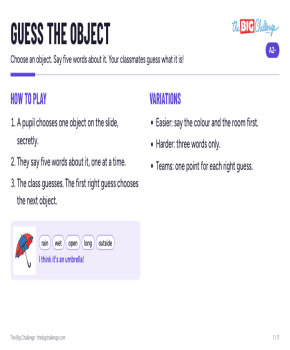
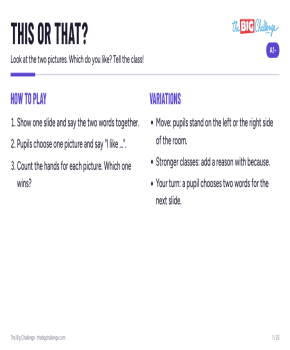
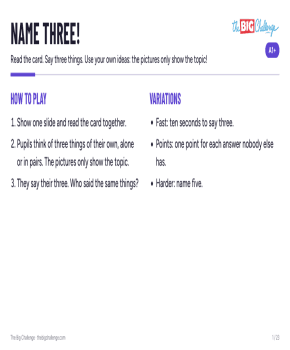
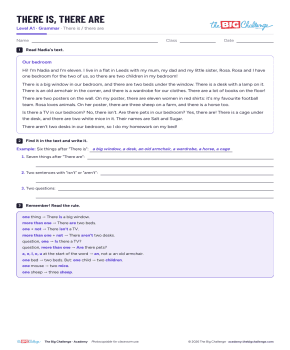
A projectable A1- speaking warm-up: 12 photos of everyday objects, such as scissors, a key or a guitar, each shown very close, closer, then whole. Pupils guess what it is with Is it a ...? and I think it's a ...
Documents to download (1)
- Slide bank In your teacher account
Teaching guide
Objective & content
By the end, A1- pupils can guess an everyday thing with Is it a ...? and I think it's a ..., and describe it with a colour or a shape. The bank is 37 projectable slides: a how-to slide, then 12 photos of everyday objects (scissors, an alarm clock, a zip, glasses, a key, a guitar, ...), each shown on three slides: very close, closer, then the whole photo with the answer.
Pedagogical guide
Use it as a five-minute warm-up or to revise object words. The close-up makes everyone look hard and guess, and the second slide gives a reason to change the guess, so pupils hear and repeat the question many times. The answer slide models It's a ... and They're .... The photos are interchangeable: show one or two per lesson.
Suggested procedure
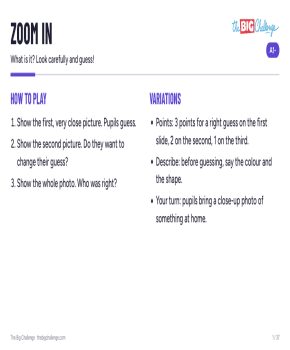
- (1 min) Show the how-to slide, then the first, very close picture. Pupils guess.
- (2 min) Show the second picture. Do they want to change their guess?
- (2 min) Show the whole photo. Who was right?
Adaptations
- [S] Before guessing, pupils say the colour and the shape.
- [A] Points: 3 for a right guess on the first slide, 2 on the second, 1 on the third. Or pupils bring a close-up photo of something at home.
Materials & prerequisites
A projector or screen; the bank is a 16:9 PDF, one slide per page, with no printing needed. Assumes a / an, plurals and basic words for things at home and at school. The photos come from Wikimedia Commons, CC0 or public domain; each one is credited on its answer slide.
Curriculum alignment
Maps to Cycle 3 "child and close environment" (FR): naming the things of everyday life.
Possible adaptations
- Lower levels: Offer segmented listening and additional visual aids.
- Advanced levels: Encourage an oral summary and a debate in English on the theme.
- Large groups: Organise group work with differentiated roles.
🔒 Restricted content
This resource requires a subscription to be viewed.
Unlock the resourceIncluded in the subscription