En resumen
Nivel de clase :4° ESO
Tipo :Audiolibros
Ejes culturales :Personas y Personajes, Vida cotidiana, Países y Paisajes, Imaginación y Leyendas
y
Embárquese con sus alumnos en un thriller psicológico trepidante en el que las apariencias engañan. «A Nose for Trouble» combina la investigación genealógica, la historia (el Titanic) y la suplantación de identidad en el ambiente refinado de la aristocracia británica. Este audiolibro de 32:58, lleno de giros inesperados, es ideal para alumnos que desean agudizar su capacidad de escucha y su espíritu crítico ante una trama con múltiples facetas.
Nivel de clase :4° ESO
Tipo :Audiolibros
Ejes culturales :Personas y Personajes, Vida cotidiana, Países y Paisajes, Imaginación y Leyendas
Oferta especial por inscripción anticipada. ¡Desbloquee este recurso inscribiendo ahora a sus alumnos en el Concurso y disfrute de nuestras ventajas exclusivas!
Objetivo y Resumen de la Trama
Objetivo : Lograr que los alumnos sigan y comprendan una trama de audio compleja, identificando los personajes clave, sus motivaciones ocultas y los diferentes niveles de la trama (pasado/presente).
Resumen : Una joven turista americana, Jessica, descubre que se parece muchísimo a un retrato en una mansión galesa. Lo que comienza como una simple curiosidad la sumerge en un oscuro secreto familiar ligado al Titanic, revelando una suplantación de identidad, un doble asesinato y el hecho de que su propia abuela es la verdadera heredera del lugar.
Desarrollo Sugerido
1. Antes de la escucha (~10 min) : ESTABLECER EL MISTERIO
Brainstorming : Discuta las palabras clave : stately home (mansión/casa señorial), aristocracy (aristocracia), heir (heredero/a), impostor (usurpador/a), proof (prueba).
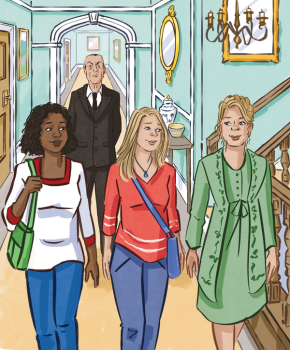
Anticipación : Presente el mapa de personajes (página 2) y pida a los alumnos que adivinen sus roles ("Who is the hero? The villain?").
2. Durante la escucha (~40 min) : SEGUIR LA INVESTIGACIÓN
Escucha fragmentada en 3 actos para gestionar la longitud y la complejidad :
Acto 1 (El misterio) : Escuche hasta el descubrimiento del retrato y el encuentro con Angela. Pausa : "What is the connection between Jessica and the portrait?".
Acto 2 (La investigación) : Escuche hasta la desaparición de la carta y la foto. Pausa : "Who are the suspects? What are they trying to hide?".
Acto 3 (La resolución) : Escuche el resto para el desenlace y el giro final.
3. Después de la escucha (~15-20 min) : DESENREDAR LA TRAMA
Discusión : "Who was the real villain: Diana or Bernard? Why? What was the biggest surprise?".
Tarea de síntesis : En grupos, creen un esquema o una línea de tiempo que retrace la maquinación de Diana (encuentro con Angela, cirugía, asesinato de la madre, etc.).
Adaptaciones
Para simplificar : Proporcione una ficha "¿Quién es quién?" (Who's who?) para completar durante la escucha (¿Quién es Diana? ¿Quién es Grace?). Revele los giros de la trama uno por uno con el profesor.
Para profundizar : Organice un mini-juicio donde los alumnos interpreten los roles de los abogados de la defensa (para Bernard) y de la acusación (para Diana), utilizando elementos de la historia como pruebas.
6 o’clock sharp 6 o’clock exactly
actually (adv.) in fact
amazing (adj.) very surprising
arrow (n.) a thin stick with a sharp point, cf. Robin Hood
batter (n.) a mixture of flour, egg and milk or water.
be in the way to block the way
blame (v.) to hold responsible
butler (n.) The butler is a domestic servant who is in charge of all the other servants.
clear (v.) When you clear a table, you remove the dirty plates and glasses.
conservatory (n.) a large room with a glass roof and walls, attached to a house and used for plants
corridor (n.) a passage between rooms
crack (n.) a small opening
curse (n.) to call on a supernatural power to punish someone
down-to-earth (adj.) very practical, with your feet on the ground
drown (v.) to die in water
duty (n.) Your duty is something you think you are obliged to do.
earl (n.) a member of the British aristocracy, the equivalent of a count
engaged (adj.) If you are engaged, you have a fiancé[e], and you’re going to get married.
expat (n.) a person who lives and works in a foreign country
extra (adj., adv.) more
feel sorry for (v.) to feel pity for
finishing school (n.) a private school where girls are prepared for life in ‘high society’
frown (v.) When you frown, you are worried or doubtful and your eyebrows come together.
gasp (v.) You gasp when you are so surprised that you can’t say anything.
hold someone tight to hold someone very firmly and stop them moving.
housekeeper (n.) A housekeeper ‘keeps house’ for someone, i.e. he/she makes sure everything is clean, well-organised, etc.
illegible (adj.) impossible to read
invaluable (adj.) essential, of very high value
jet lag (n.) tiredness after a long flight that has crossed several time zones
lane (n.) a narrow country road
laundry (n.) a place where they wash dirty clothes, etc.
look forward to (v.) to be impatient for something to happen
luggage (n. sing. inv.) bags, suitcases
maiden voyage (n.) the very first voyage of a ship
odd (adj.) strange on the house You don’t have to pay.
overhear (v.) to hear a conversation when the people who are talking don’t know you are listening
pack (v.) to put things in a suitcase or a bag
plastic surgeon (n.) a doctor who changes people’s faces, noses, etc. and sometimes makes them look younger
plump (adj.) rather fat
pose (v.) to stand in a certain position for a photo or a portrait, for example
priceless (adj.) so valuable that it has no price
proud (adj.) very satisfied with yourself
prove (v.), proof (n.) You prove your identity to someone when you show your identity papers – they are proof of your identity.
purse (n.) You carry a purse or a wallet to put your money in.
recipe (n.) the list of ingredients and the method for cooking something
rent (v.) to pay to use something for a short time
rural (adj.) the opposite of urban, i.e. not in or very close to a town
save (v.) keep safely (especially for computers)
scary (adj.) frightening
scream (v.) to shout loudly when you are very frightened or very excited
search (v.) to look for set the table to put the knives, forks, spoons, plates, glasses, etc. on the table
shadow (n.) a dark area where there is no light because something is blocking the sun, the moon, etc.
sight (n.) the ability to see
sinister (adj.) A person looks sinister when he/she looks frightening and you think he/she might harm you.
sink (sunk, sunk) (v.) When a ship sinks, it goes to the bottom of
tear (tore, torn) (v.) If something is torn, there is a piece missing or it is damaged.
tip (n.) the top, the end or the edge of something
trace (n.) If there is no trace of someone it means nothing is left to show that the person was here or to show where he or she has gone.
train (v.) to learn a job
treasure (n.) something that is very valuable
trouble (n.) difficulty, problems
ugly (adj.) the opposite of beautiful
upset (adj.) worried, unhappy
upset (v.) to worry someone or make someone unhappy
vulture (n.) a large bird that feeds on dead animals
wealth (n.); wealthy (adj.) riches; rich
weird (adj.) strange
wonder (v.) to ask yourself, to be curious to know
yawn (v.) When you are tired, you often open your mouth wide and yawn.
Please wait...