What Do You Do After School?
Interactive exercises to consolidate your students’ learning.
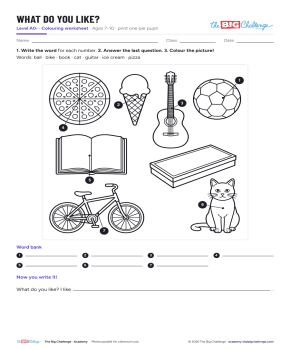
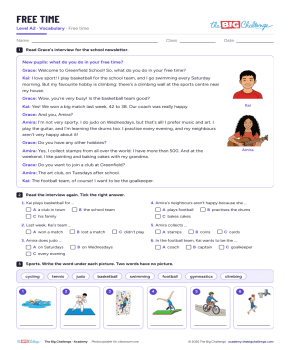
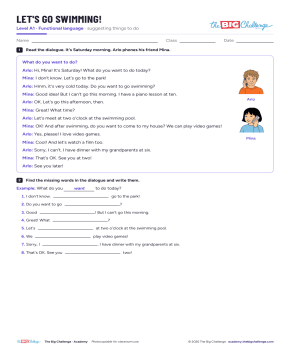
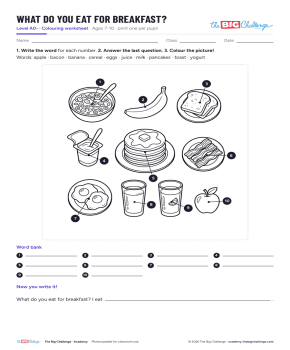
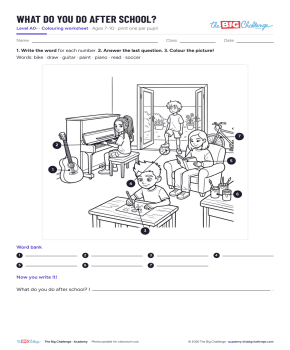
A colouring sheet for true beginners that goes with the Now You Say It episode What Do You Do After School?: the after-school club, with each child busy at one activity. Pupils write the word for each number, say what they do, then colour, with the teacher key on page two.
Documents to download (2)
- Colouring worksheet In your teacher account
- Colouring worksheet (black and white) In your teacher account
Teaching guide
Objective & content
A two-page printable that goes with the Now You Say It episode What Do You Do After School?: the after-school club, with each of four children busy at one activity. Pupils write the word for each numbered thing, say what they do after school themselves, then colour the scene, with the teacher key on page two.
Pedagogical guide
Draw, read, play, piano, guitar, paint and bike are A1 in the glossary; soccer is A2, an exception already approved for this module and used again here. Each child is doing exactly what the episode says: Max draws, Mila plays the piano, Luna reads and Ben plays soccer, with three more things lying about the room for whoever wants them, so there is always a next word to reach for.
Suggested procedure
- (3 min) Ask about each child in turn: "What does Mila do after school?" The class answers together, as in the episode.
- (10 min) Hand out page 1. Pupils write the word for each numbered thing from the list.
- (5 min) Pupils answer the last line about themselves.
- (5 min) Correct from page 2.
- (10 min) Colouring.
Adaptations
[S] Read the word list aloud and let pupils match number to word.
[A] Fold the word list away, then let each pupil add their own after-school activity to the picture.
Materials & prerequisites
Page 1 printed for every pupil, plus coloured pencils. Keep page 2, the teacher key. Black and white printing is enough and is what the sheet is designed for.
Possible adaptations
- Lower levels: Offer segmented listening and additional visual aids.
- Advanced levels: Encourage an oral summary and a debate in English on the theme.
- Large groups: Organise group work with differentiated roles.
🔒 Restricted content
This resource requires a subscription to be viewed.
Unlock the resourceIncluded in the subscription