What Do You Eat for Breakfast?
Interactive exercises to consolidate your students’ learning.
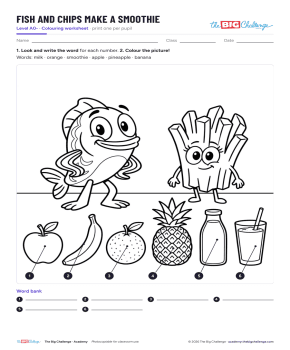
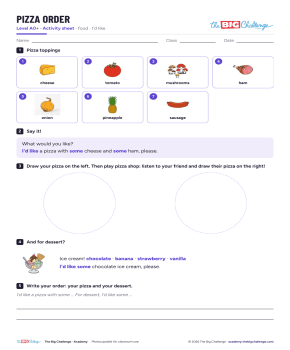
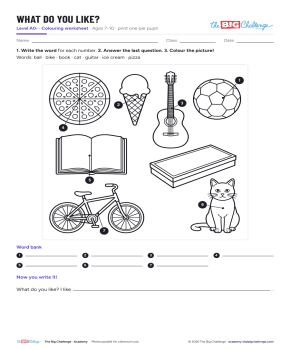
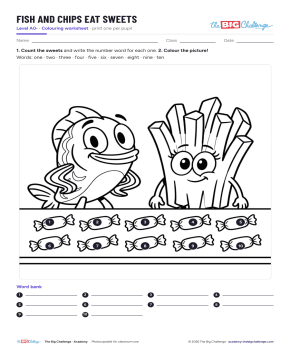
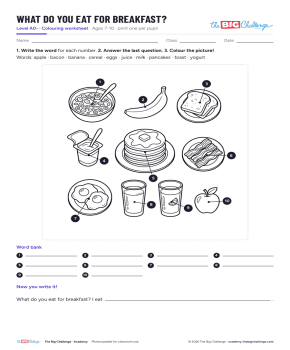
A colouring sheet for true beginners that goes with the Now You Say It episode What Do You Eat for Breakfast?: a breakfast table seen from above with ten things on it. Pupils write the word for each number, say what they eat, then colour, with the teacher key on page two.
Documents to download (2)
- Colouring worksheet In your teacher account
- Colouring worksheet (black and white) In your teacher account
Teaching guide
Objective & content
A two-page printable that goes with the Now You Say It episode What Do You Eat for Breakfast?: a breakfast table seen from above with ten things on it. Pupils write the word for each numbered food, say what they eat for breakfast themselves, then colour the picture, with the teacher key on page two.
Pedagogical guide
Every one of the ten words is A1 in the glossary. There are no characters on this sheet: the words are the food itself, which is exactly what the episode's question asks about, and ten things is more than any other sheet in the module, because breakfast is the one subject where a child already has plenty to say.
Suggested procedure
- (3 min) Ask the question round the class first: "What do you eat for breakfast?" Let pupils point at what they eat before writing anything.
- (10 min) Hand out page 1. Pupils write the word for each numbered food from the list.
- (5 min) Pupils answer the last line about themselves.
- (5 min) Correct from page 2.
- (10 min) Colouring.
Adaptations
[S] Read the word list aloud and let pupils match number to word.
[A] Fold the word list away and let pupils write from memory, then circle the ones they really eat.
Materials & prerequisites
Page 1 printed for every pupil, plus coloured pencils. Keep page 2, the teacher key. Black and white printing is enough and is what the sheet is designed for.
Possible adaptations
- Lower levels: Offer segmented listening and additional visual aids.
- Advanced levels: Encourage an oral summary and a debate in English on the theme.
- Large groups: Organise group work with differentiated roles.
🔒 Restricted content
This resource requires a subscription to be viewed.
Unlock the resourceIncluded in the subscription