How Are You?
Interactive exercises to consolidate your students’ learning.
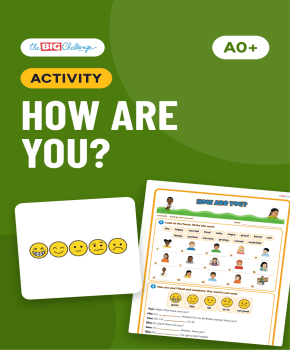
Pupils meet fifteen feelings: they write the right word under each face (happy, sad, angry, scared, tired, surprised, bored, excited, worried, nervous, proud, shy, calm, grumpy, lonely). Then they read two short dialogues and complete them with great, fine, so-so or not great, and answer "How are you?" for themselves. Answer key included.
Documents to download (2)
- Colour version In your teacher account
- Black and white version In your teacher account
Teaching guide
Objective & content
This activity sheet is about fifteen feelings and the question How are you? Pupils write the word under each of fifteen faces, then complete two dialogues with the five answers on a scale from great to not great. By the end, pupils name a wide range of feelings and answer How are you? I'm fine, thanks. And you?
Pedagogical guide
Task 1 shows fifteen faces and a word box with the fifteen words; pupils write each word once under the right face. The first eight are the common ones; seven more (worried, nervous, proud, shy, calm, grumpy, lonely) go a little beyond the usual A0+ lists and are learned through the faces. In task 2 pupils read two dialogues, Tom and Mia, then Ella and Sam, and fill four gaps from a strip of five answers on a scale: Mia is great (it is her birthday), Tom is not great (he is ill), Sam is fine and Ella is so-so (she has a test). OK is the word left over. In the last line pupils answer "How are you?" for themselves, with "I'm ... because ...". Page 2 gives the answer key and the teacher notes.
Suggested procedure
- (5 min) Mime a few feelings and let the class guess.
- (10 min) Task 1: pupils write the word under each face; check with the answer key.
- (10 min) Task 2: pupils read the two dialogues and fill the gaps; one word is not used.
- (5 min) Pupils answer the last question for themselves, then pairs read the dialogues aloud.
Adaptations
[S] Say each word with a mime and let pupils copy it.
[A] Pupils write a third dialogue with a partner.
Materials & prerequisites
One copy per pupil of page 1, in colour or black and white. Pupils need a pencil. Page 2 is the answer key with teacher notes: keep it. Pupils need no feelings words before the sheet: the faces teach them. Allow time for task 1, which has the most words.
Possible adaptations
- Lower levels: Offer segmented listening and additional visual aids.
- Advanced levels: Encourage an oral summary and a debate in English on the theme.
- Large groups: Organise group work with differentiated roles.
🔒 Restricted content
This resource requires a subscription to be viewed.
Unlock the resourceIncluded in the subscription