I Spy in the Park!
Interactive exercises to consolidate your students’ learning.
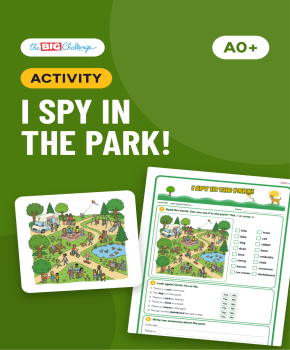
A big, busy picture of a park. Pupils read sixteen words and tick the ones they can find in the park (four are not there), then read six sentences ("There is a cat in the tree.") and circle Yes or No. Last, they write two sentences of their own about the park. Answer key included.
Documents to download (2)
- Colour version In your teacher account
- Black and white version In your teacher account
Teaching guide
Objective & content
This activity sheet is a seek-and-find page built around one big, busy picture of a park: an ice cream van, a picnic, a playground, a pond with ducks, people walking, cycling and skateboarding. Pupils read sixteen words and look for each one in the picture, then read six short sentences about the park and decide if they are true, and finally write two sentences of their own. By the end, pupils read and recognise park words (kite, bike, swing, slide, bench, skateboard...) and understand and write short sentences with There is and I can see ("There is a cat in the tree.").
Pedagogical guide
The English is in the reading: there are no pictures next to the words, so pupils must read each one before they look for it. Task 1 is a list of sixteen words with a box for each; pupils tick the words they can find in the park and cross the ones that are not there. Twelve are in the picture (kite, bike, cat, dog, duck, boat, bird, swing, slide, bench, ice cream, skateboard) and four are not (train, rabbit, umbrella, snowman), so a pupil who ticks every box gets four wrong. Task 2 asks for reading and looking together: six sentences, and pupils circle Yes or No for each ("The dog is in the pond." is No: the dog is on the path). The sentences use there is, in and on, and has got. Task 3 gives two sentence starters, "I can see" and "There is", for pupils to write about the park; they read their sentences to a partner, who finds the thing in the picture. Page 2 gives the answer key and the teacher notes.
Suggested procedure
- (5 min) Look at the picture together for a minute: "What can you see?"
- (10 min) Task 1: pupils read each word, look for it in the park and tick or cross it; check together.
- (10 min) Task 2: pupils read the six sentences, look again and circle Yes or No.
- (5 min) Task 3: pupils write two sentences about the park.
- (10 min) In pairs, pupils read their sentences aloud; the partner finds the thing in the picture.
Adaptations
[S] Read the word list aloud together before pupils look for the words.
[A] Pupils write a Yes / No sentence about the park for a partner.
Materials & prerequisites
One copy per pupil of page 1, in colour if possible, so the details of the picture are easy to see. Pupils need a pencil. Page 2 is the answer key with teacher notes: keep it. Pupils should have met there is and a few words for things in the street and the park; the sixteen words are short and everyday.
Possible adaptations
- Lower levels: Offer segmented listening and additional visual aids.
- Advanced levels: Encourage an oral summary and a debate in English on the theme.
- Large groups: Organise group work with differentiated roles.
🔒 Restricted content
This resource requires a subscription to be viewed.
Unlock the resourceIncluded in the subscription