Spot the Difference
Interactive exercises to consolidate your students’ learning.
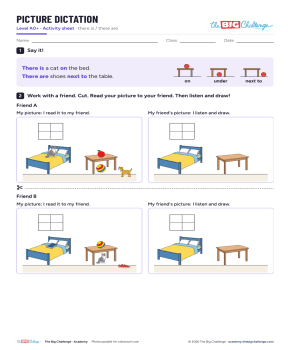
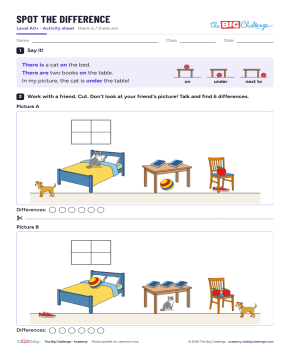
Pupils cut the sheet in two and each keeps one bedroom picture hidden from their partner. Taking turns, they say where things are with "there is", "there are", "on", "under" and "next to" until they find the six differences. Answer key included.
Documents to download (2)
- Colour version In your teacher account
- Black and white version In your teacher account
Teaching guide
Objective & content
Two pictures of the same bedroom, with a bed, a table, a chair, a cat, a dog, a ball, books, apples and a pair of shoes, but six things are not the same. Pupils work in pairs, each with one picture they keep hidden, and talk until they find the six differences. By the end, pupils say where things are with there is and there are and the prepositions on, under and next to: "There is a cat on the bed."
Pedagogical guide
"Say it!" gives three model sentences ("There is a cat on the bed.", "There are two books on the table.", "In my picture, the cat is under the table!") and three small pictures of a ball on, under and next to a table. Task 2 is a speaking game: pupils cut the sheet along the line, each keeps Picture A or Picture B and must not look at the other one. They take turns describing their picture, and each time they find a difference they both tick one of the six circles. The six differences: the cat is on the bed or under the table; the ball is under the table or on the bed; there are two or three books on the table; there is one apple or there are two apples on the chair; the dog is next to the bed or next to the chair; the shoes are under the chair or next to the bed. Since nobody sees both pictures, pupils have to speak and listen to find them. Page 2 gives the six differences as full sentences, with the teacher notes.
Suggested procedure
- (5 min) Put a ball on, under and next to a table and ask "Where is the ball?".
- (5 min) Read "Say it!" together; pupils repeat the three sentences.
- (5 min) Pupils sit in pairs and cut the sheet along the line; each keeps one picture hidden.
- (15 min) Pairs take turns describing their pictures and tick a circle for each difference they find.
- (5 min) Pupils put the two pictures side by side and check; correct with the answer key.
Adaptations
[S] Give the words first: cat, dog, ball, books, apples, shoes, bed, table, chair.
[A] Pupils write three differences: "In picture A, the dog is next to the bed."
Materials & prerequisites
One copy of page 1 per pair, in colour or black and white, and scissors to cut it in two. Pupils need a pencil to tick the circles. Page 2 is the answer key with teacher notes: keep it. A ball and a table help for the warm-up. Pupils should know the words for the things in the room and the numbers one to three.
Possible adaptations
- Lower levels: Offer segmented listening and additional visual aids.
- Advanced levels: Encourage an oral summary and a debate in English on the theme.
- Large groups: Organise group work with differentiated roles.
🔒 Restricted content
This resource requires a subscription to be viewed.
Unlock the resourceIncluded in the subscription