Picture Dictation
Interactive exercises to consolidate your students’ learning.
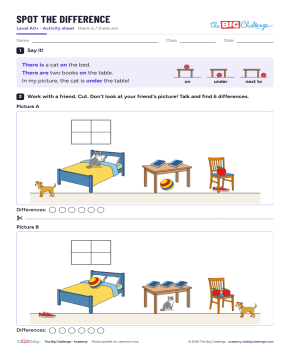
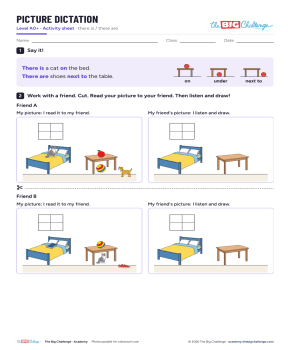
A pair activity for "there is" and "there are" with "on", "under" and "next to". Pupils cut the sheet in two: each reads their bedroom picture aloud, four sentences, while a friend draws it in an empty room. Then they swap and compare the two pictures; the sentences for the teacher are included.
Documents to download (2)
- Colour version In your teacher account
- Black and white version In your teacher account
Teaching guide
Objective & content
In this pair activity, pupils describe a picture of a bedroom while a friend draws it. Each pupil has a room with a bed and a table, and four things on, under or next to them, such as a cat, a ball or shoes. One friend reads their picture aloud, the other listens and draws in an empty room, then they swap and compare. By the end, pupils say and understand there is and there are with on, under and next to.
Pedagogical guide
The listener has to make the picture from what they hear, so the speaker has to be exact and the listener has to catch every word. The Say it! box gives the two sentence patterns (There is a cat on the bed. and There are shoes next to the table.) with a small picture for each of on, under and next to. The sheet is cut in two: Friend A and Friend B each have their own picture and an empty room to draw in, and must not look at each other's half. Each picture takes four sentences, such as There is a ball under the table. Putting the two pictures side by side at the end shows straight away what was said or heard wrongly, and it is always good fun. Page 2 gives the four sentences for each picture and the teacher notes.
Suggested procedure
- (5 min) Draw a bed and a table on the board and dictate one thing to the class: "There is a ball under the table." A pupil draws it.
- (5 min) Read the Say it! box together; practise on, under and next to with classroom objects.
- (5 min) In pairs, pupils cut the sheet in two along the dotted line; each keeps one half and does not show it.
- (10 min) Friend A reads their picture aloud, one sentence at a time; Friend B draws in the empty room.
- (10 min) They swap: Friend B reads, Friend A draws.
- (5 min) Friends put the pictures side by side: are they the same? Check with the sentences on page 2.
Adaptations
[S] Before the pairs start, write the eight words on the board (bed, table, cat, ball, apple, dog, book, shoes) with a quick sketch of each.
[A] The listener asks questions to check before drawing ("Is the cat on the bed?").
Materials & prerequisites
One copy of page 1 per pair, in colour or black and white, scissors to cut it in two, and pencils. Quick drawings are fine (a circle for a ball). Page 2 has the sentences for both pictures and the teacher notes: keep it. Pupils should know most of the eight words in the pictures; the Say it! box gives them the sentence patterns they need.
Possible adaptations
- Lower levels: Offer segmented listening and additional visual aids.
- Advanced levels: Encourage an oral summary and a debate in English on the theme.
- Large groups: Organise group work with differentiated roles.
🔒 Restricted content
This resource requires a subscription to be viewed.
Unlock the resourceIncluded in the subscription