Votes for Women, Explained
Una risorsa didattica pensata per dare slancio alle sue lezioni di inglese.
La serie
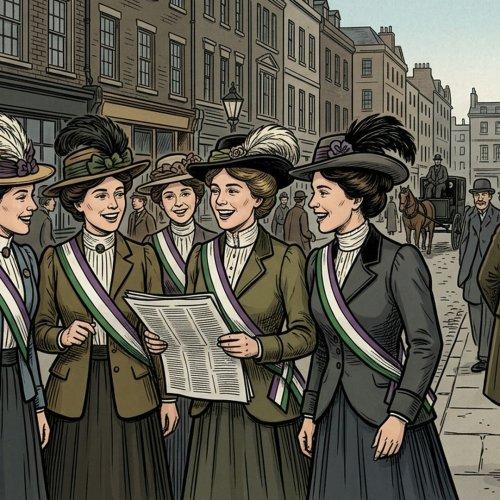
Una serie illustrata a due voci sulla lotta per il voto alle donne in Gran Bretagna e negli Stati Uniti, dagli anni Quaranta dell'Ottocento al 1965, con uno sguardo a Nuova Zelanda, Germania, Francia e Svizzera. Il conduttore americano Alex e la conduttrice britannica Sam dialogano alla pari e ciascuno porta il punto di vista del proprio paese: perché le donne non potevano votare, dove cominciò la lotta, che cosa fecero le suffragette, come la Prima guerra mondiale cambiò le cose e chi dovette aspettare ancora. Ogni episodio risponde a una domanda e finisce con una sorpresa.
Gli episodi (5)
 1
Before the 1860s women could not vote in Britain or the United States, for three reasons: an idea (separate spheres: politics for men, the home for women), a law (coverture: a married woman was one person in law with her husband, and her property was his), and property (in Britain the vote went with property, so most men could not vote either; the 1832 Reform Act then wrote 'male' into the law for the first time). America dropped the property test for white men by the 1850s. The twist: in New Jersey some women voted from 1776 until a law of 1807 took the vote away from women and free Black men.
6:50 2
The organised fight for women's votes began in the 1840s-1860s. In America it began in London: at the 1840 World Anti-Slavery Convention the women delegates were made to sit apart, and Elizabeth Cady Stanton and Lucretia Mott planned a women's rights meeting. It came in 1848 at Seneca Falls ('all men and women are created equal'); the vote was the only demand not accepted by everyone, and Frederick Douglass spoke for it. In Britain it began with the 1866 petition of about 1,500 women, presented by John Stuart Mill, and his 1867 attempt to change 'man' to 'person' (196 to 73 against). After the Civil War the 15th Amendment gave Black men the vote but not women, and the movement split; Wyoming gave women the vote in 1869.
6:40 3
Deeds, Not Words: The Suffragettes
Around 1900 British women still could not vote for Parliament. Millicent Fawcett's suffragists (1897), the larger group, campaigned peacefully; Emmeline Pankhurst's WSPU (1903) chose 'Deeds, not words': prison, the Daily Mail's mocking nickname 'suffragettes' (1906) taken as their own name, windows and fires, hunger strikes and force-feeding, the 1913 Cat and Mouse Act, Emily Davison at the Derby (1913); the campaign stopped in August 1914. Alice Paul learnt the methods in Britain, met Lucy Burns in a London police station, and took them home: the 1913 Washington march (Ida B. Wells refused to march at the back) and the Silent Sentinels at the White House (1917).
6:42 4
How Did the First World War Change Things?
In August 1914 the campaigns paused and both groups helped the war effort without dropping their claim. Women took men's jobs: buses, railways, the Women's Land Army, and almost a million in munitions by 1918, and some MPs changed their minds. The 6 February 1918 law gave the vote to almost all men over 21 and to women over 30 who met a property test (about 8.5 million women); MPs said openly that 30 was chosen so women would not be a majority of voters, so many of the young war workers were left out. Markievicz was elected in December 1918; Astor was the first to sit (1919). In the US, the Hello Girls and others served; Wilson called suffrage 'a vitally necessary war measure' (September 1918); Congress passed the 19th Amendment in 1919; Tennessee, tied 48-48 in August 1920, ratified it when Harry Burn, 24, changed his vote after his mother's letter.
6:09 5
1918 and 1920 were not the end. Britain gave women the vote at 21 like men in July 1928 (about five million more women); Pankhurst died weeks before. In the US, the 19th Amendment barred refusing the vote because of sex, not race: in the South, poll taxes, reading tests run by white officials, threats and lost jobs kept many Black women and men from voting until the Voting Rights Act of August 1965 (Fannie Lou Hamer as an example). Native Americans, citizens from 1924, were barred in some states until 1948 and 1957; Asian immigrants could not become citizens until 1943 and 1952. Around the world: New Zealand 1893, Germany November 1918, France April 1944 (after the Senate said no), Switzerland 1971 (Appenzell 1990).
6:37
Guida didattica
Obiettivo e contenuti
Votes for Women, Explained è una serie audio illustrata sulla lotta per il voto alle donne in Gran Bretagna e negli Stati Uniti, dagli anni Quaranta dell'Ottocento al 1965, raccontata da due voci: il conduttore Alex, che è americano, e la conduttrice Sam, che è britannica. Dialogano alla pari, e ciascuno porta il punto di vista del proprio paese sulla stessa storia. Ogni episodio dura circa sei o sette minuti, è illustrato in uno stile da fumetto disegnato a china e risponde a una domanda: perché le donne non potevano votare? Dove cominciò la lotta? Perché le suffragette infransero la legge? Come cambiò le cose la Prima guerra mondiale? Chi dovette aspettare ancora? Si incontrano luoghi e persone reali (Elizabeth Cady Stanton e Lucretia Mott, da una riunione a Londra nel 1840 fino a Seneca Falls nel 1848; Emmeline Pankhurst e le suffragette; Alice Paul, che portò i loro metodi in America; Fannie Lou Hamer nel Mississippi), e le date chiave (1918 e 1928 in Gran Bretagna, 1920 e 1965 in America) sono presentate come fatti. La storia si chiude con uno sguardo a Nuova Zelanda, Germania, Francia e Svizzera. La serie è di livello B1-, e ogni episodio finisce con una sorpresa.
Guida didattica
Ogni episodio si apre con la sigla e un saluto, e si chiude con ciò che viene dopo, così gli alunni possono seguire la serie in ordine o usare un episodio da solo. Il lavoro sulla lingua riguarda il past simple per la storia e la grammatica della spiegazione: could e couldn't per ciò che era permesso, had to per le regole del passato, e le domande con why, how e did. Ogni episodio ha un quiz di 18 domande nell'app (fatti, parole e grammatica), e l'app mostra solo sottotitoli in inglese. Per ogni episodio ci sono una scheda di classe di una pagina con le soluzioni, una scheda di esercizi fronte e retro, un piano di lezione di 45 minuti e una propria pagina per l'insegnante. I due conduttori sono alla pari, così la classe può fare un confronto con il proprio paese: l'ultimo episodio dà le date della Germania (1918) e della Francia (1944). Le parti difficili sono dette in modo breve e semplice: il carcere e gli scioperi della fame, la morte di Emily Davison al Derby, la poll tax (una somma da pagare prima di poter votare) e i test di lettura nel Sud degli Stati Uniti, e Fannie Lou Hamer che perse il lavoro e la casa per aver cercato di votare. Un punto merita di essere spiegato in classe, perché gli episodi lo sfiorano soltanto: in America le regole del voto erano decise stato per stato. Dal 1920 le donne nere votavano negli stati del Nord, ma nel Sud la maggior parte delle donne nere, come gli uomini neri, non poté votare fino al Voting Rights Act del 1965.
Svolgimento suggerito
- Scegliete l'episodio e scrivete la sua domanda alla lavagna; gli alunni indovinano la risposta.
- Gli alunni ascoltano tutto l'episodio una volta, poi verificano le loro ipotesi.
- Ascoltano una seconda volta, con alcune pause per domande brevi.
- Rispondono al quiz nell'app: prima i fatti, poi le parole, poi la grammatica.
- In classe, usate la scheda di una pagina o la scheda di esercizi, oppure seguite il piano di lezione di 45 minuti nella pagina dell'episodio.
- A coppie, gli alunni fanno il conduttore e la conduttrice e spiegano la domanda dell'episodio con parole proprie.
- Fate ascoltare l'episodio successivo quando la classe è pronta: la storia va dagli anni Quaranta dell'Ottocento al 1965.
Adattamenti possibili
- Livelli più fragili: proponga un ascolto a tratti e supporti visivi complementari.
- Livelli avanzati: incoraggi un riassunto orale e un dibattito in inglese sul tema.
- Classi numerose: organizzi un lavoro a isole con ruoli differenziati.
🔒 Contenuto riservato
Questa risorsa richiede un abbonamento per essere consultata.
Sbloccare la risorsaIncluso nell'abbonamento