Who Ate the Cake?
Interactive exercises to consolidate your students’ learning.
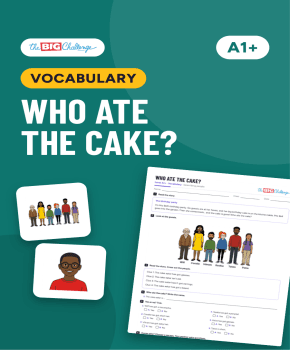
Pupils solve a detective puzzle: they read a short story about a missing birthday cake, look at six party guests and read four clues (glasses, isn't old, hasn't got earrings, has got a beard), crossing out the people it can't be, to find who ate the cake. Then they tick Yes or No for six sentences and play Guess who? with a partner (Has he got glasses? Yes, he has. / No, he hasn't.). Answer key included.
Documents to download (2)
- Colour version In your teacher account
- Black and white version In your teacher account
Teaching guide
Objective & content
This worksheet is a detective puzzle about He's got / She's got, He hasn't got / She hasn't got and Has he got glasses? Yes, he has. / No, he hasn't. Pupils read a story about a missing birthday cake, use four clues to find the guest who ate it, tick Yes or No for six sentences and play Guess who? with a partner.
Pedagogical guide
Task 1 is a short story: it is Mrs Bell's birthday party, and her cake is gone. The picture shows six guests, each with a name under the drawing (Wilf, Coralie, Vikram, Saskia, Taiwo, Petra). Pupils read four clues one by one (the cake eater has got glasses; isn't old; hasn't got earrings; has got a beard) and cross out the people it can't be; after the last clue one guest is left, and pupils write the name. Then pupils tick Yes or No for six sentences about the guests, for example Wilf has got a moustache. The last box, Guess who?, gives the questions for the game: Has he got glasses? Yes, he has. / No, he hasn't. and Is she tall? Yes, she is. / No, she isn't. Page 2 gives the answer key and the teacher notes.
Suggested procedure
- (5 min) Pupils read the story and look at the six guests; ask what each one looks like.
- (8 min) Pupils read the clues one by one and cross out the people it can't be; they write the name.
- (5 min) Pupils tick Yes or No for the six sentences; check with the answer key.
- (7 min) Pairs play Guess who?: one pupil chooses a guest, the other asks questions.
Adaptations
[S] Do the first clue together and cross out the first people on the board.
[A] Pupils write four clues for another person in the picture.
Materials & prerequisites
One copy per pupil of page 1, in colour or black and white. Pupils need a pencil to cross out and tick. Page 2 is the answer key with teacher notes: keep it. Pupils should know the words for hair and faces (glasses, a beard, earrings) and have got; the sheet practises them, so it works well after Hair, Eyes and Glasses!
Possible adaptations
- Lower levels: Offer segmented listening and additional visual aids.
- Advanced levels: Encourage an oral summary and a debate in English on the theme.
- Large groups: Organise group work with differentiated roles.
🔒 Restricted content
This resource requires a subscription to be viewed.
Unlock the resourceIncluded in the subscription