Sell it to the world
A teaching resource designed to energise your English lessons.
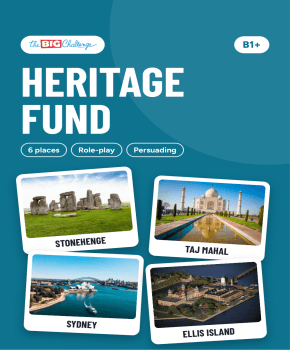
A role-play board meeting at BBC Studios, the BBC's commercial arm: there is money for one world campaign, and four teams pitch Planet Earth, Doctor Who, Bluey and Strictly Come Dancing. Each card gives three real facts, the team's role in the game and one hard objection: is the show really British soft power? Groups pitch, answer their objection, fill a listening grid, then vote for a show that is not their own. Four cards, a tips page, a listening grid and a teacher page; about 50 minutes.
Documents to download (1)
- Fact files, speaking tips, listening grid In your teacher account
Teaching guide
Objective & content
A B2 role-play about British soft power through entertainment. The board of BBC Studios, the BBC's commercial arm, which makes and sells programmes and formats abroad, has money for one world campaign, and four teams want it: Planet Earth, Doctor Who, Bluey and Strictly Come Dancing (sold abroad as Dancing with the Stars). Four cards, two to a page, each give a photo, three real facts, the team's role in the game and one objection to answer. By the end, pupils can pitch a position, concede what is true in an objection and still defend their case, using contrast and concession (although, whereas, despite, nevertheless).
Pedagogical guide
The facts on the cards are real and checked; the board meeting, the campaign and each team's position are invented for the game, and the card says so. Each objection asks whether the show is really British soft power: a nature series made with American, Japanese and Canadian partners, a streaming deal that ended in 2025, a cartoon made in Australia, a format the world knows under another name. There is no right answer: reward the group that admits what is true in the objection before it answers. The task follows on from the World Service reading, which defines soft power through the news; here pupils turn to entertainment.
Suggested procedure
- (5 min) Make four groups (or eight, two per show) and give each group one card. Read the question on the tips page together.
- (15 min) Groups prepare a two-minute pitch and an answer to the objection on their card, with the tips page.
- (15 min) The board meeting: each group pitches, reads its objection aloud and answers it. The class fills the grid.
- (10 min) The vote: each group votes for one show, but not its own. Count the votes, then ask the grid question: is the winner really British soft power?
Adaptations
[S] Groups prepare three sentences (what the show is, one fact, why it should win) and answer the objection in one sentence.
[A] Each pupil writes a 150-word letter to the board for the show that won, with one concession (Although ...) and one fact from another card.
Materials & prerequisites
The two card pages, cut in half along the dashed line (one card per group); the tips page and the listening grid for every pupil; the teacher page. The World Service reading is a good way in, but not required.
Possible adaptations
- Lower levels: Offer segmented listening and additional visual aids.
- Advanced levels: Encourage an oral summary and a debate in English on the theme.
- Large groups: Organise group work with differentiated roles.
🔒 Restricted content
This resource requires a subscription to be viewed.
Unlock the resourceIncluded in the subscription