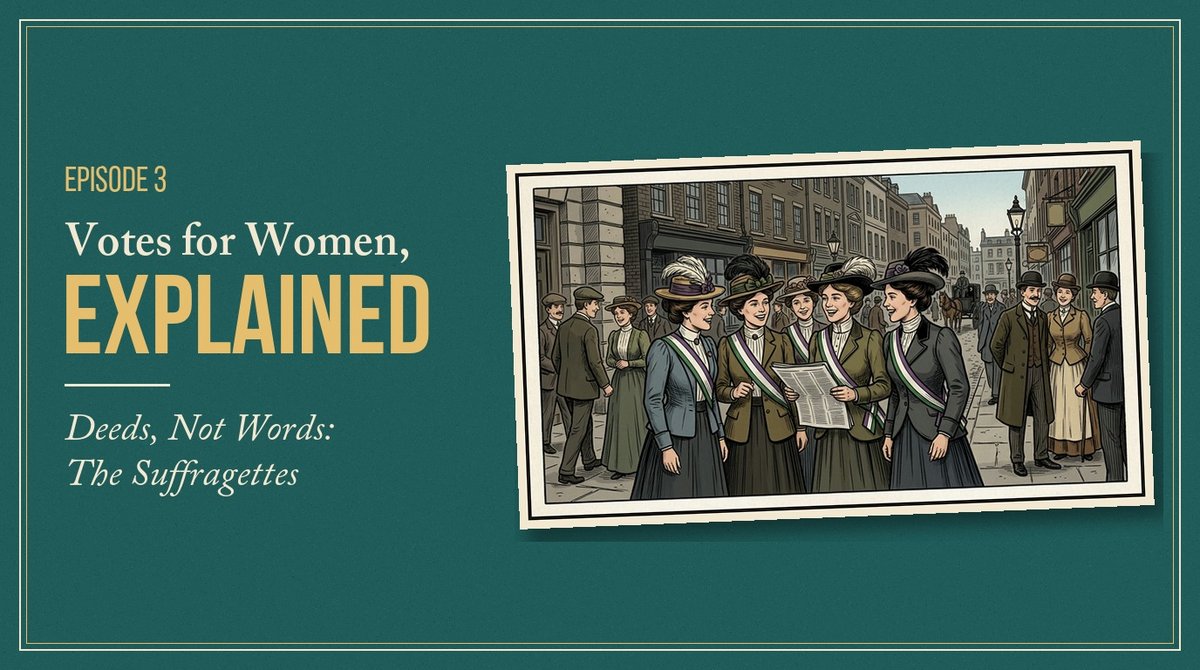
Deeds, Not Words: The Suffragettes
Episode of the series Votes for Women, Explained
- Illustrated slideshow (29 images)
- Glossary (34 words)
- Comprehension quiz (18 questions)
- 18 cultural notes
 Extract · 30 s
The episode
Around 1900 British women still could not vote for Parliament. Millicent Fawcett's suffragists (1897), the larger group, campaigned peacefully; Emmeline Pankhurst's WSPU (1903) chose 'Deeds, not words': prison, the Daily Mail's mocking nickname 'suffragettes' (1906) taken as their own name, windows and fires, hunger strikes and force-feeding, the 1913 Cat and Mouse Act, Emily Davison at the Derby (1913); the campaign stopped in August 1914. Alice Paul learnt the methods in Britain, met Lucy Burns in a London police station, and took them home: the 1913 Washington march (Ida B. Wells refused to march at the back) and the Silent Sentinels at the White House (1917).
Episode worksheets (2)
- Student sheet In your teacher account
- Teacher sheet In your teacher account
Teaching guide
Objective & content
Two hosts, one American and one British, ask why some women broke the law to win the vote, and tell a mostly British story with an American ending. Learners practise the past simple (started, called, smashed, took, went, met), the past passive without the doer to say what happened to someone (two of her members were sent to prison; she was arrested seven times), couldn't for what was not allowed (women still couldn't vote in elections to Parliament) and past simple questions with did (Why did some women break the law?). They listen for names, years and the two groups, then answer the quiz in the app and the one-page pupil sheet. The story follows these beats:
- Britain, around 1900: women still couldn't vote, so the campaign grew; in 1897 many groups joined together under Millicent Fawcett, whose big, peaceful group (the suffragists) used meetings, letters, petitions and marches.
- In 1903, in Manchester, Emmeline Pankhurst started a new group for women only, because she thought the peaceful way was too slow; her motto was "Deeds, not words".
- In 1905 two of her members were sent to prison, and in January 1906 the Daily Mail called them "suffragettes" to make fun of them; the women took the name for themselves.
- From 1912, suffragettes smashed shop windows in London and started fires in post boxes and empty buildings; many went to prison, some went on hunger strike and were force-fed, and in 1913 the "Cat and Mouse Act" sent them home when they got ill and back to prison when they got better. These facts are told plainly.
- At the Derby in June 1913, Emily Davison stepped in front of the King's horse and died four days later; historians are not sure why. People still argue about whether the deeds worked, and Fawcett's peaceful group kept going: both groups were part of the story, until the war began in August 1914.
- The American ending: Alice Paul joined the suffragettes in England and met Lucy Burns in a London police station; in March 1913 she organised a big march in Washington, where Ida B. Wells, told to march at the back, joined the women from her state; in 1917 the Silent Sentinels stood outside the White House.
The hosts open and close this episode with a short hello and goodbye.
Pedagogical guide
The 45-minute lesson plan starts from a question for the class: words or actions, how can people change a law? Learners give ideas, listen twice (once for the two groups, once with four pauses for questions), then practise facts, vocabulary and the grammar of the past: the past simple, the past passive, couldn't and questions with did. The two hosts are equals who each bring their own country's view. The idea to repeat is that an insult became a name, and that both groups are part of the story: a "Words" column and a "Deeds" column on the board. Prison, hunger strikes, force-feeding and Emily Davison's death are told plainly: the plan lets the audio play on through them and sets no question or task on them, and never asks why Davison did it. The windows and fires are neither praised nor condemned. Most activities have a support path and a stretch path.
Suggested procedure
- Activate knowledge (3 min): ask how people can change a law, with words or with actions, and collect ideas.
- Vocabulary preview (4 min): campaign, peaceful, motto, deed, insult, protest, march, arrest, banner, method.
- First listen (9 min): play the whole episode (about 6 minutes 40 seconds, with the theme tune and the hosts' hello) and ask which group used words and which used actions.
- Second listen (11 min): pause four times, after "In 1912, they even called their newspaper The Suffragette.", after "Then came fires, in post boxes and empty buildings.", after "Then, in August 1914, the war began, and the suffragettes stopped." and after "So she marched where she wanted.", to ask short questions.
- Comprehension check (4 min): the Facts part of the pupil sheet (questions 1 to 6, as in the app quiz).
- Vocabulary practice (4 min): the Vocabulary part (questions 7 to 12).
- Grammar focus (6 min): put facts of the story in the past simple, review the past passive, couldn't and a question with did, then the Grammar part (questions 13 to 18).
- Speaking (4 min): in pairs, students play the two hosts and ask and answer questions about Fawcett, Pankhurst and the name "suffragettes", ending on the hosts' last lines.
Materials & prerequisites
- The episode in the app, with its quiz.
- The one-page pupil sheet (18 items: facts, vocabulary, grammar) and its answer key, in the episode's printables.
- The two-sided differentiated worksheet and its answer key, for homework or a second lesson.
- Prerequisites: the past simple of regular and irregular verbs, was and were, can and can't, and years in English.
Possible adaptations
- Lower levels: Offer segmented listening and additional visual aids.
- Advanced levels: Encourage an oral summary and a debate in English on the theme.
- Large groups: Organise group work with differentiated roles.
🔒 Restricted content
This resource requires a subscription to be viewed.
Unlock the resourceIncluded in the subscriptionTags
- Documentary
- Past simple: regular verbs
- Past simple: irregular verbs
- Past simple: was / were
- Passive voice basics
- Wh- questions
- Society & politics
- Government
- Protest
- Civil rights
- Historical dates
- Women's suffrage
- Forms of commitment
- Encountering others
- Listening comprehension
- Cultural awareness
- Vocabulary building
- Citizenship & society
- Modern history
- Our World
- Past & Progress