Where Did the Fight Begin?
Episode of the series Votes for Women, Explained
- Illustrated slideshow (29 images)
- Glossary (34 words)
- Comprehension quiz (18 questions)
- 18 cultural notes
 Extract · 30 s
The episode
The organised fight for women's votes began in the 1840s-1860s. In America it began in London: at the 1840 World Anti-Slavery Convention the women delegates were made to sit apart, and Elizabeth Cady Stanton and Lucretia Mott planned a women's rights meeting. It came in 1848 at Seneca Falls ('all men and women are created equal'); the vote was the only demand not accepted by everyone, and Frederick Douglass spoke for it. In Britain it began with the 1866 petition of about 1,500 women, presented by John Stuart Mill, and his 1867 attempt to change 'man' to 'person' (196 to 73 against). After the Civil War the 15th Amendment gave Black men the vote but not women, and the movement split; Wyoming gave women the vote in 1869.
Episode worksheets (2)
- Student sheet In your teacher account
- Teacher sheet In your teacher account
Teaching guide
Objective & content
Two hosts, one American and one British, ask where the fight for women's vote began, and follow it from a meeting in London to America and back to Britain. Learners practise the past simple (walked, signed, met, made, wrote, took, gave), could and couldn't for what was possible or allowed, had to for what was necessary, the past continuous for an action in progress (Parliament was writing a new voting law) and past simple questions with did (Where did it finally happen?). They listen for places, years and names, then answer the quiz in the app and the one-page pupil sheet. The story follows these beats:
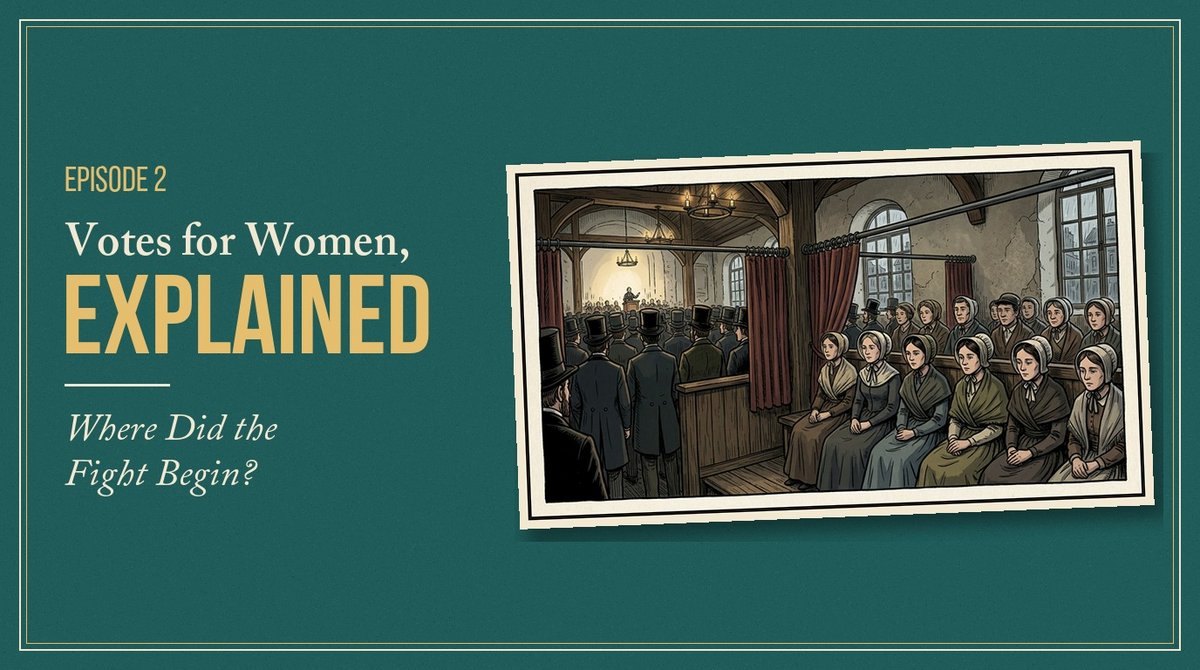
- London, 1840: at the World Anti-Slavery Convention, the men voted, and the women delegates could come in but couldn't take part; they had to sit apart, behind a curtain.
- Elizabeth Cady Stanton met Lucretia Mott there, and on a walk through London they made a plan for a meeting about women's rights in America.
- Seneca Falls, 1848: about three hundred women and men copied the American declaration of 1776 with one new line, "All men and women are created equal"; the vote was the only demand that not everyone accepted, Frederick Douglass spoke up for it, and one hundred people signed.
- Britain, the 1860s: about fifteen hundred women signed a petition, and John Stuart Mill took it to Parliament (with a story about an apple seller's stall); the next year he asked MPs to change "man" to "person" in a new voting law, and they said no, 196 votes to 73.
- In 1870 the Fifteenth Amendment said that no one could lose the vote because of their race, so Black men could vote, but not women, and the American movement split in two.
- In December 1869, Wyoming gave women the vote, more than fifty years before all American women could vote.
The hosts open and close this episode with a short hello and goodbye.
Pedagogical guide
The 45-minute lesson plan starts from a question for the class: where and when did women start to ask for the vote? Learners guess, listen twice (once for where the fight began and where it grew, once with four pauses for questions), then practise facts, vocabulary and the grammar of the past: the past simple, could, couldn't and had to, the past continuous and questions with did. The two hosts are equals who each bring their own country's view. The idea to repeat is a small change of words, twice: "All men and women are created equal" at Seneca Falls, and "man" to "person" in Britain. Mill's words are given in simple reported words, and the apple stall is told as a story; the plan says so. Race and the vote are told plainly, and the lesson keeps that tone: the plain fact that the movement split, no judging of the people of the past. Most activities have a support path and a stretch path.
Suggested procedure
- Activate knowledge (3 min): ask where and when women started to ask for the vote, and collect guesses.
- Vocabulary preview (4 min): convention, delegate, curtain, declaration, equal, demand, petition, sign, MP, amendment.
- First listen (9 min): play the whole episode (about 6 minutes 40 seconds, with the theme tune and the hosts' hello) and ask where the fight began and where it grew.
- Second listen (11 min): pause four times, after "And on that walk, they made a plan: a meeting about women's rights, back in America.", after "Douglass was one of them.", after "A hundred and ninety-six votes to seventy-three." and after "Because it left women out.", to ask short questions.
- Comprehension check (4 min): the Facts part of the pupil sheet (questions 1 to 6, as in the app quiz).
- Vocabulary practice (4 min): the Vocabulary part (questions 7 to 12).
- Grammar focus (6 min): put facts of the story in the past simple, review could, couldn't and had to, the past continuous and a question with did, then the Grammar part (questions 13 to 18).
- Speaking (4 min): in pairs, students play the two hosts and ask and answer questions about London, Seneca Falls and the British petition, ending on the hosts' last lines.
Materials & prerequisites
- The episode in the app, with its quiz.
- The one-page pupil sheet (18 items: facts, vocabulary, grammar) and its answer key, in the episode's printables.
- The two-sided differentiated worksheet and its answer key, for homework or a second lesson.
- Prerequisites: the past simple of regular and irregular verbs, was and were, can and can't, and years in English.
Possible adaptations
- Lower levels: Offer segmented listening and additional visual aids.
- Advanced levels: Encourage an oral summary and a debate in English on the theme.
- Large groups: Organise group work with differentiated roles.
🔒 Restricted content
This resource requires a subscription to be viewed.
Unlock the resourceIncluded in the subscriptionTags
- Documentary
- Past simple: regular verbs
- Past simple: irregular verbs
- Past simple: was / were
- Modals in the past
- Wh- questions
- Negation: do / does / did
- Society & politics
- Government
- Civil rights
- History of slavery
- Historical dates
- Women's suffrage
- Forms of commitment
- Encountering others
- Listening comprehension
- Cultural awareness
- Vocabulary building
- Citizenship & society
- Modern history
- Our World
- Past & Progress