Why Couldn't Women Vote?
Episode of the series Votes for Women, Explained
- Illustrated slideshow (30 images)
- Glossary (35 words)
- Comprehension quiz (18 questions)
- 17 cultural notes
 Extract · 30 s
The episode
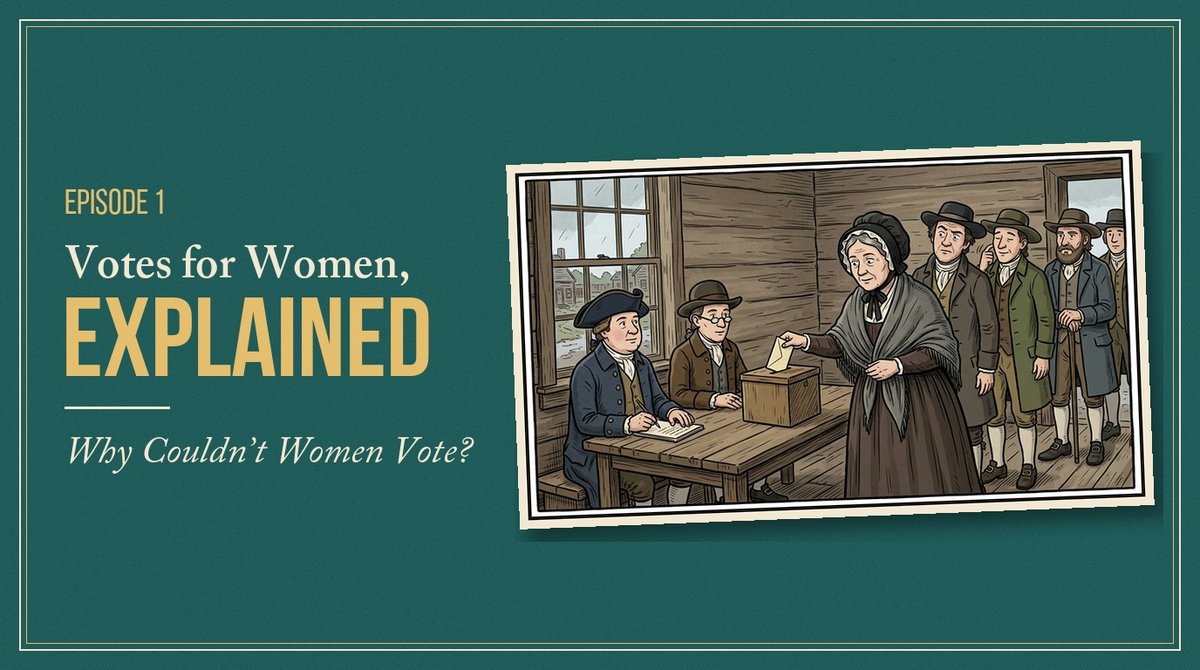
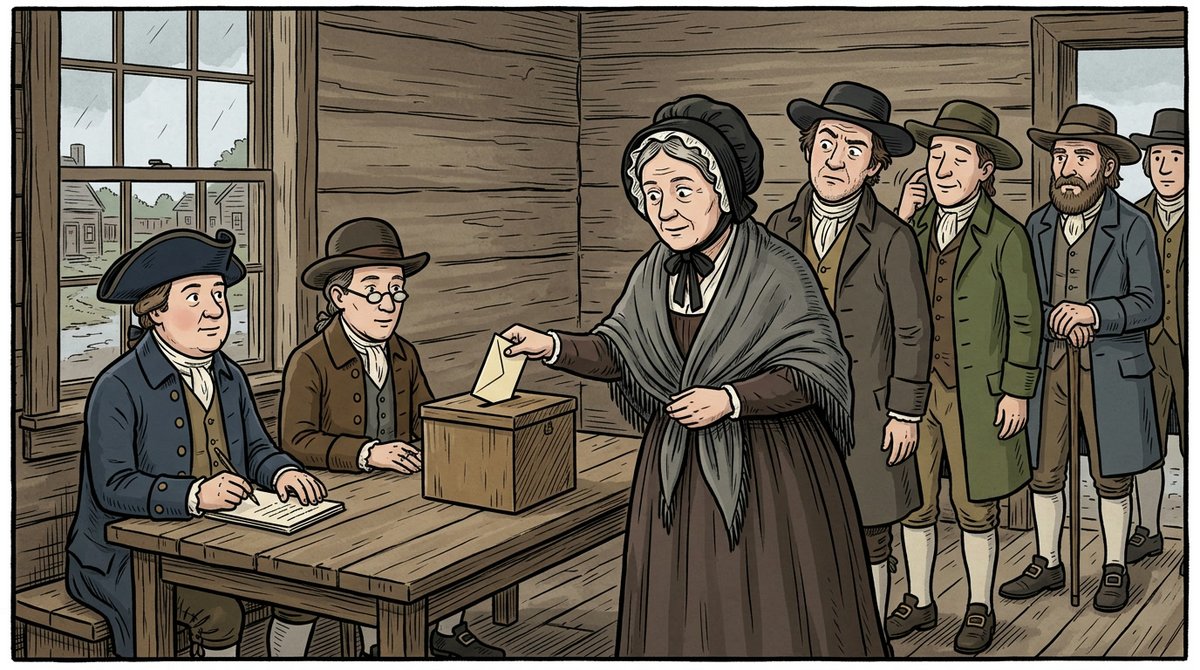
Before the 1860s women could not vote in Britain or the United States, for three reasons: an idea (separate spheres: politics for men, the home for women), a law (coverture: a married woman was one person in law with her husband, and her property was his), and property (in Britain the vote went with property, so most men could not vote either; the 1832 Reform Act then wrote 'male' into the law for the first time). America dropped the property test for white men by the 1850s. The twist: in New Jersey some women voted from 1776 until a law of 1807 took the vote away from women and free Black men.
Episode worksheets (2)
- Student sheet In your teacher account
- Teacher sheet In your teacher account
Teaching guide
Objective & content
Two hosts, one American and one British, ask why women could not vote in Britain and America before the 1860s, and start from a puzzle: some American women voted more than two hundred years ago, and then they lost the vote. Learners practise the past simple (voted, owned, passed, wrote, lost), couldn't for what was not possible or not allowed, had to and needed to for what was necessary, and relative clauses with who (widows who had enough property); questions with why and couldn't (So why couldn't she vote?) come back in the pupil sheet. They listen for reasons, years and names, then answer the quiz in the app and the one-page pupil sheet. The story follows these beats:
- The idea: "separate spheres", the public world of work and politics for men and the home for women; some said women could influence their husbands at home.
- The law: coverture, from England, explained by William Blackstone in 1765; husband and wife were one person in law, and everything a married woman owned became her husband's.
- Property: in Britain you usually needed land or a house of a certain value to vote, so most men could not vote either; a few unmarried women and widows with property voted.
- The Great Reform Act of 1832 gave the vote to more men and said for the first time that a voter had to be male; the same year, Mary Smith, from Yorkshire, sent a petition to Parliament.
- In America, states dropped their property rules, and by the 1850s almost every white man could vote, but many states wrote the word "white" into the law.
- The puzzle: in New Jersey, from 1776, unmarried women and widows with enough property voted, and free Black men with property voted too, until a law of 1807 said that only free white men could vote.
The hosts open and close this episode with a short hello and goodbye.
Pedagogical guide
The 45-minute lesson plan starts from a question for the class: who could vote two hundred years ago? Learners guess, listen twice (once for the three reasons and the New Jersey story, once with four pauses for questions), then practise facts, vocabulary and the grammar of the past: the past simple, couldn't, had to and needed to, and who. The two hosts are equals who each bring their own country's view. Two quotes are simplified, and the plan says so. Race and the vote are told plainly in the episode, and the lesson keeps that tone: say the facts and the dates once, and do not ask pupils to judge the people of the past or to imagine how they felt. The idea to repeat is the hosts' answer: an idea, a law and property kept women out. Most activities have a support path and a stretch path.
Suggested procedure
- Activate knowledge (3 min): ask who could vote two hundred years ago, and collect guesses.
- Vocabulary preview (4 min): vote, property, law, husband and wife, widow, tax, petition, constitution, unfair.
- First listen (9 min): play the whole episode (about 6 minutes 50 seconds, with the theme tune and the hosts' hello) and ask for the three reasons and what happened in New Jersey.
- Second listen (11 min): pause four times, after "And it leads to reason number two: the law.", after "Why give one family two votes?", after "The MP who read it out said that some members would find it funny." and after "So what went wrong?", to ask short questions.
- Comprehension check (4 min): the Facts part of the pupil sheet (questions 1 to 6, as in the app quiz).
- Vocabulary practice (4 min): the Vocabulary part (questions 7 to 12).
- Grammar focus (6 min): join facts with who, review the past simple, couldn't, had to and needed to, and the question "Why couldn't she vote?", then the Grammar part (questions 13 to 18).
- Speaking (4 min): in pairs, students play the two hosts and ask and answer questions about the three reasons and New Jersey, ending on the hosts' last lines.
Materials & prerequisites
- The episode in the app, with its quiz.
- The one-page pupil sheet (18 items: facts, vocabulary, grammar) and its answer key, in the episode's printables.
- The two-sided differentiated worksheet and its answer key, for homework or a second lesson.
- Prerequisites: the past simple of regular and irregular verbs, was and were, could and can't, and years in English.
Possible adaptations
- Lower levels: Offer segmented listening and additional visual aids.
- Advanced levels: Encourage an oral summary and a debate in English on the theme.
- Large groups: Organise group work with differentiated roles.
🔒 Restricted content
This resource requires a subscription to be viewed.
Unlock the resourceIncluded in the subscriptionTags
- Documentary
- Past simple: regular verbs
- Past simple: irregular verbs
- Past simple: was / were
- Modals in the past
- Relative clauses
- Negation: do / does / did
- Society & politics
- Government
- Civil rights
- Family
- Historical dates
- Women's suffrage
- Forms of commitment
- Encountering others
- Listening comprehension
- Cultural awareness
- Vocabulary building
- Citizenship & society
- Modern history
- Our World
- Past & Progress