Votes for Women, Explained
A teaching resource designed to energise your English lessons.
About the series
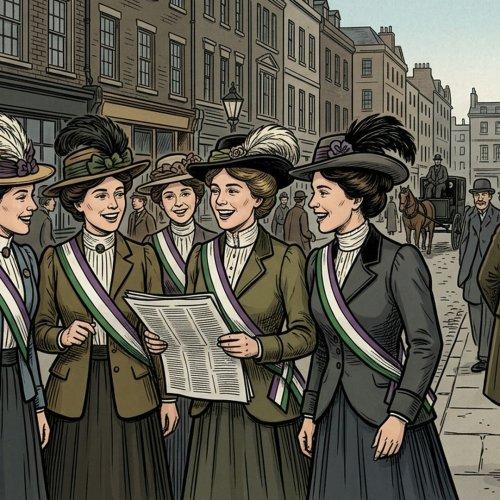
A two-voice illustrated explainer of the fight for votes for women in Britain and the United States, from the 1840s to 1965, with a look at New Zealand, Germany, France and Switzerland. The two hosts, Alex (American) and Sam (British), talk as equals and each brings their own country's view: why women could not vote, where the fight began, what the suffragettes did, how the First World War changed things, and who still had to wait. Each episode answers one question and ends on a surprise.
Episodes (5)
 1
Before the 1860s women could not vote in Britain or the United States, for three reasons: an idea (separate spheres: politics for men, the home for women), a law (coverture: a married woman was one person in law with her husband, and her property was his), and property (in Britain the vote went with property, so most men could not vote either; the 1832 Reform Act then wrote 'male' into the law for the first time). America dropped the property test for white men by the 1850s. The twist: in New Jersey some women voted from 1776 until a law of 1807 took the vote away from women and free Black men.
6:50 2
The organised fight for women's votes began in the 1840s-1860s. In America it began in London: at the 1840 World Anti-Slavery Convention the women delegates were made to sit apart, and Elizabeth Cady Stanton and Lucretia Mott planned a women's rights meeting. It came in 1848 at Seneca Falls ('all men and women are created equal'); the vote was the only demand not accepted by everyone, and Frederick Douglass spoke for it. In Britain it began with the 1866 petition of about 1,500 women, presented by John Stuart Mill, and his 1867 attempt to change 'man' to 'person' (196 to 73 against). After the Civil War the 15th Amendment gave Black men the vote but not women, and the movement split; Wyoming gave women the vote in 1869.
6:40 3
Deeds, Not Words: The Suffragettes
Around 1900 British women still could not vote for Parliament. Millicent Fawcett's suffragists (1897), the larger group, campaigned peacefully; Emmeline Pankhurst's WSPU (1903) chose 'Deeds, not words': prison, the Daily Mail's mocking nickname 'suffragettes' (1906) taken as their own name, windows and fires, hunger strikes and force-feeding, the 1913 Cat and Mouse Act, Emily Davison at the Derby (1913); the campaign stopped in August 1914. Alice Paul learnt the methods in Britain, met Lucy Burns in a London police station, and took them home: the 1913 Washington march (Ida B. Wells refused to march at the back) and the Silent Sentinels at the White House (1917).
6:42 4
How Did the First World War Change Things?
In August 1914 the campaigns paused and both groups helped the war effort without dropping their claim. Women took men's jobs: buses, railways, the Women's Land Army, and almost a million in munitions by 1918, and some MPs changed their minds. The 6 February 1918 law gave the vote to almost all men over 21 and to women over 30 who met a property test (about 8.5 million women); MPs said openly that 30 was chosen so women would not be a majority of voters, so many of the young war workers were left out. Markievicz was elected in December 1918; Astor was the first to sit (1919). In the US, the Hello Girls and others served; Wilson called suffrage 'a vitally necessary war measure' (September 1918); Congress passed the 19th Amendment in 1919; Tennessee, tied 48-48 in August 1920, ratified it when Harry Burn, 24, changed his vote after his mother's letter.
6:09 5
1918 and 1920 were not the end. Britain gave women the vote at 21 like men in July 1928 (about five million more women); Pankhurst died weeks before. In the US, the 19th Amendment barred refusing the vote because of sex, not race: in the South, poll taxes, reading tests run by white officials, threats and lost jobs kept many Black women and men from voting until the Voting Rights Act of August 1965 (Fannie Lou Hamer as an example). Native Americans, citizens from 1924, were barred in some states until 1948 and 1957; Asian immigrants could not become citizens until 1943 and 1952. Around the world: New Zealand 1893, Germany November 1918, France April 1944 (after the Senate said no), Switzerland 1971 (Appenzell 1990).
6:37
Teaching guide
Objective & content
Votes for Women, Explained is an illustrated audio series about the fight for votes for women in Britain and the United States, from the 1840s to 1965, told by two hosts: Alex, who is American, and Sam, who is British. They talk as equals, and each brings their own country's view of the same story. Each episode lasts about six or seven minutes, is illustrated in a hand-inked comic style, and answers one question: Why couldn't women vote? Where did the fight begin? Why did the suffragettes break the law? How did the First World War change things? Who still had to wait? The story meets real places and real people (Elizabeth Cady Stanton and Lucretia Mott, from a meeting in London in 1840 to Seneca Falls in 1848; Emmeline Pankhurst and the suffragettes; Alice Paul, who took their methods home to America; Fannie Lou Hamer in Mississippi), and the key dates (1918 and 1928 in Britain, 1920 and 1965 in America) are told as facts. The story ends with a look at New Zealand, Germany, France and Switzerland. The series is at B1-, and each episode ends on a surprise.
Pedagogical guide
Every episode opens with the theme tune and a hello, and ends with what comes next, so pupils can follow the series in order or take one episode alone. The language work is the past simple for history and the grammar of explaining: could and couldn't for what was allowed, had to for rules in the past, and questions with why, how and did. Each episode has an 18-question quiz in the app (facts, words and grammar), and the app shows English subtitles only. Around each episode there is a one-page class pack with an answer key, a two-sided worksheet, a 45-minute lesson plan and its own teacher page. The two hosts are equals, so a class can compare with its own country: the last episode gives the dates for Germany (1918) and France (1944). The hard parts are said briefly and plainly: prison and hunger strikes, Emily Davison's death at the Derby, the poll tax (money you had to pay before you could vote) and the reading tests in the American South, and Fannie Lou Hamer losing her job and her home for trying to vote. One point is worth saying in class, because the episodes only touch on it: in America, the voting rules were set state by state. From 1920, Black women voted in northern states, but in the South most Black women, like Black men, could not vote until the Voting Rights Act of 1965.
Suggested procedure
- Choose the episode and write its question on the board; pupils guess the answer.
- Pupils listen to the whole episode once, then check their guesses.
- They listen a second time, with a few pauses for short questions.
- They answer the quiz in the app: facts, then words, then grammar.
- In class, use the one-page pack or the worksheet, or follow the 45-minute lesson plan on the episode's page.
- In pairs, pupils play the two hosts and explain the episode's question in their own words.
- Play the next episode when the class is ready: the story goes from the 1840s to 1965.
Possible adaptations
- Lower levels: Offer segmented listening and additional visual aids.
- Advanced levels: Encourage an oral summary and a debate in English on the theme.
- Large groups: Organise group work with differentiated roles.
🔒 Restricted content
This resource requires a subscription to be viewed.
Unlock the resourceIncluded in the subscription