Coming to America, Explained
A teaching resource designed to energise your English lessons.
About the series
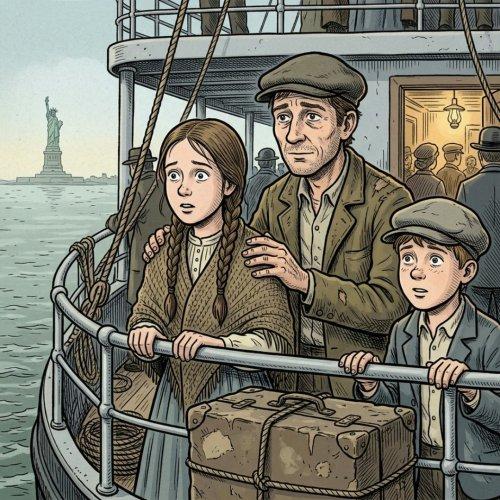
A two-voice illustrated explainer of the great migration to America, from the 1840s to the 1920s. In five short episodes of about six minutes, the two hosts, Alex (American) and Sam (British), talk as equals and each brings their own country's view: why millions left Europe, how they crossed the ocean, the two doors of Ellis Island and Angel Island, whether America was welcoming, and who stayed and who came next. Each episode answers one question and ends on a surprise.
Episodes (5)
 1
Why Did Millions Leave Europe?
Between the 1840s and the 1910s, more than thirty million Europeans went to the United States, one of the biggest movements of people in history. Hunger, poverty, no land, no work and persecution pushed them out (the Irish famine, when Ireland was part of the United Kingdom; landless farmers in the south of Italy; Jewish families in the Russian Empire); jobs, land and freedom pulled them to America. The surprise is how the poorest paid for the crossing: very often, family already in America sent the money or a ticket.
6:12 2
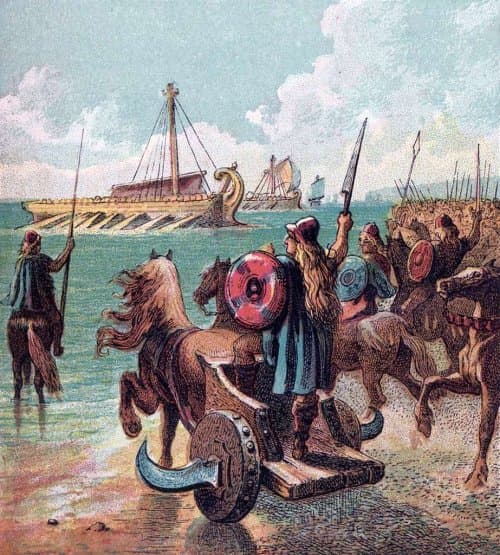
Between the 1840s and the 1910s, millions of emigrants crossed the Atlantic, most from Liverpool (about nine million between 1830 and 1930), the Irish also from Cobh (Queenstown) and the Germans from Hamburg and Bremen. Most travelled in steerage, the cheapest ticket, below deck, with simple food, and laws slowly set rules for space and air. Steam replaced sail: the crossing fell from five or six weeks to less than two weeks by the 1870s and about eight days by 1910. The surprise: the ticket did not get cheaper. What fell was the time, and, against wages, the cost.
5:49 3
Two Doors: Ellis Island and Angel Island
America had two main doors for newcomers. Ellis Island, in New York harbour (1892-1954), checked more than twelve million people: steerage passengers climbed the stairs under a doctor's eye, got a chalk letter if something looked wrong, had their eyelids turned up, and answered the questions on the ship's list; most were through in three to five hours and about two in a hundred were sent back. Angel Island, in San Francisco Bay (1910-1940), received about half a million people, mostly from Asia; Chinese newcomers faced detailed questions about home and many waited weeks, some months, because of the 1882 law explained in ep-04. In 1970 a ranger found about two hundred poems carved in its walls.
5:54 4
Life for many newcomers was hard: crowded tenements (Riis, 1890: about three in four New Yorkers). Where they came from changed (northern and western Europe in 1882, southern and eastern Europe by 1907, about four million Italians). Some Americans did not want them: 'No Irish need apply' in newspaper job ads (real; the window signs are argued over). Then the laws: the Chinese Exclusion Act of 1882 (Chinese workers barred, no citizenship; permanent 1902; ended 1943, 105 a year), the 1917 reading test, the 1924 quotas (Italy from over 200,000 a year to under 4,000; almost no one from Asia; no limit for the Americas). Twist: Emma Lazarus's poem (1883) went up on a plaque in the pedestal only in 1903.
6:17 5
Did They Stay, and Who Came Next?
Many newcomers went home: Italian 'birds of passage' (from about one in four to more than half by different estimates; 73 in 100 in 1907-1911 by one count); Jewish families from the Russian Empire mostly stayed. About a third of Americans or more have an Ellis Island ancestor. What stayed: pizza (Lombardi's, often called the first, 1905), words (bagel, kindergarten, chutzpah), the St Patrick's Day parade (1760s, older than the country). Who came next: in 1848 a treaty moved the border (about half of Mexico's land; about 80,000 Mexicans had a year to choose); from the 1910s, and above all in the 1920s, Mexicans went north to farms and railways (as many as 600,000 legal arrivals in the 1920s); the 1924 law set no quota for the Americas.
5:55
Teaching guide
Objective & content
Coming to America, Explained is an illustrated audio series about the great migration to the United States, from the 1840s to the 1920s, told by two hosts: Alex, who is American, and Sam, who is British. They talk as equals, and each brings their own country's view of the same story. Each of the five episodes lasts about six minutes, is illustrated in a hand-inked comic style, and answers one question: Why did millions leave Europe? How did they get there? What happened at the two doors, Ellis Island in New York and Angel Island in San Francisco? Was America welcoming? Did they stay, and who came next? The story meets real places and real people (Annie Moore, the first person through Ellis Island; the poet Emma Lazarus), and the laws that closed the door (1882, 1917, 1924) are told as facts, with their dates and numbers. The five episodes are at A2+, and each ends on a surprise.
Pedagogical guide
Every episode opens with the theme tune, a hello and the story so far, and ends with what comes next, so pupils can follow the series in order or take one episode alone. The language work is the past simple for history and the grammar of explaining: because, so and but, could and had to for rules in the past, comparing, and questions with did, How much and How many. Each episode has an 18-question quiz in the app (facts, words and grammar), and the app shows English subtitles. Around each episode there is a one-page class pack with an answer key, a two-sided worksheet, a 45-minute lesson plan and its own teacher page. The two hosts are equals, so a class can compare with its own country: many of our pupils' families have their own stories of leaving and arriving, to share only if they wish. The history is told in broad strokes and kept factual, and the hard parts (hunger, the Chinese Exclusion Act, the quotas) are said briefly and calmly.
Suggested procedure
- Choose the episode and write its question on the board; pupils guess the answer.
- Pupils listen to the whole episode once, then check their guesses.
- They listen a second time, with a few pauses for short questions.
- They answer the quiz in the app: facts, then words, then grammar.
- In class, use the one-page pack or the worksheet, or follow the 45-minute lesson plan on the episode's page.
- In pairs, pupils play the two hosts and explain the episode's question in their own words.
- Play the next episode when the class is ready: the story goes from the 1840s to the 1920s.
Possible adaptations
- Lower levels: Offer segmented listening and additional visual aids.
- Advanced levels: Encourage an oral summary and a debate in English on the theme.
- Large groups: Organise group work with differentiated roles.
🔒 Restricted content
This resource requires a subscription to be viewed.
Unlock the resourceIncluded in the subscription