Two Doors: Ellis Island and Angel Island
Episode of the series Coming to America, Explained
- Illustrated slideshow (23 images)
- Glossary (39 words)
- Comprehension quiz (18 questions)
- 17 cultural notes
 Extract · 30 s
The episode
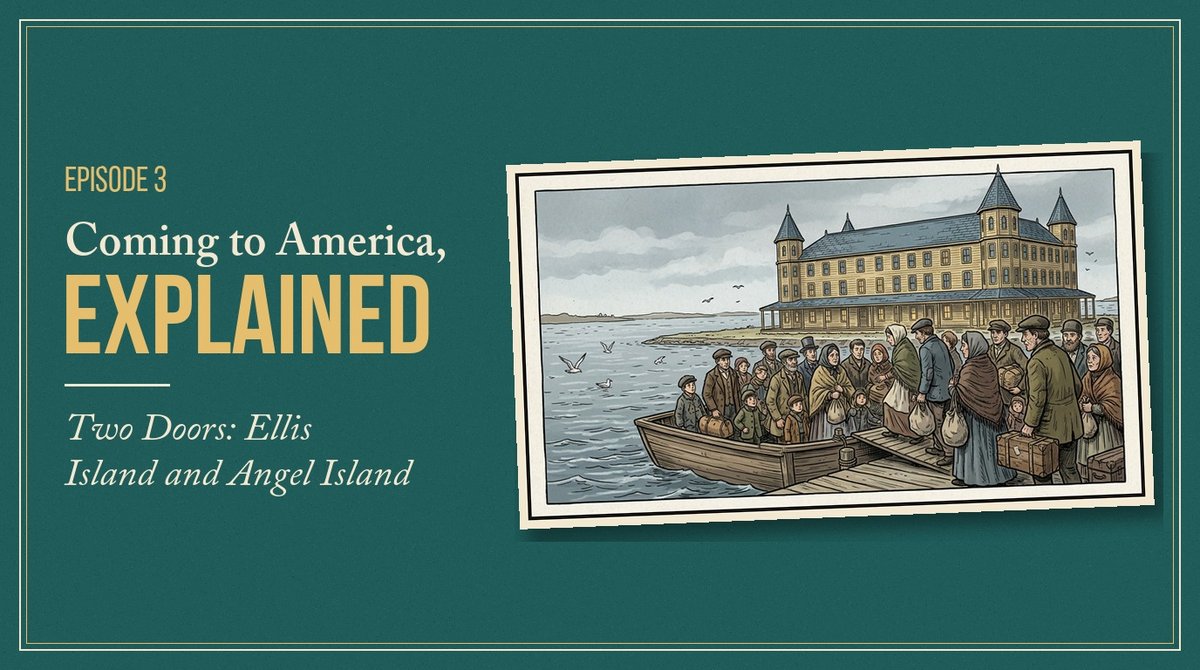
America had two main doors for newcomers. Ellis Island, in New York harbour (1892-1954), checked more than twelve million people: steerage passengers climbed the stairs under a doctor's eye, got a chalk letter if something looked wrong, had their eyelids turned up, and answered the questions on the ship's list; most were through in three to five hours and about two in a hundred were sent back. Angel Island, in San Francisco Bay (1910-1940), received about half a million people, mostly from Asia; Chinese newcomers faced detailed questions about home and many waited weeks, some months, because of the 1882 law explained in ep-04. In 1970 a ranger found about two hundred poems carved in its walls.
Episode worksheets (2)
- Student sheet In your teacher account
- Teacher sheet In your teacher account
Teaching guide
Objective & content
Two hosts, one American and one British, ask what happened when the newcomers arrived in America, and start from three strange questions about a home: how many windows, where the rice is, how many pigs the neighbour has. These were real questions that some newcomers had to answer. Learners practise the past simple (opened, climbed, checked, gave, wrote, found), could for what was possible in the past, and questions with do and does (How many windows does your house have?); the lesson plan and the pupil sheet add the link words because, but and so, and who, which and where, on facts of the story. They listen for places, years and numbers, then answer the quiz in the app and the one-page pupil sheet. The story follows these beats:
- The first door, Ellis Island in New York harbour, opened on the first day of 1892; the first person through was Annie Moore, a girl of seventeen from Cork, in Ireland.
- First- and second-class passengers were checked on the ship, so the island was mostly for the cheapest tickets.
- On the island: doctors watched people climb a long staircase and marked a problem with a chalk letter on the coat; an inspector checked each person's answers against the ship's list.
- For most people it took three to five hours; more than twelve million came through, and about two in every hundred were sent back.
- The second door, Angel Island in San Francisco Bay, from 1910: many Chinese newcomers answered small questions about home, a relative answered the same ones, and many waited weeks, because of a law from 1882 that the next episode explains.
- In 1970, a park ranger found about two hundred Chinese poems cut into the wooden walls; the building is a museum today. Same country, two very different welcomes.
The hosts open and close this episode with a short hello and goodbye.
Pedagogical guide
The 45-minute lesson plan starts from questions about the classroom, like the strange questions of the episode. Learners guess why officers asked such questions, listen twice (once for the two doors, once with four pauses for questions), then practise facts, vocabulary and the grammar of explaining and asking. The two hosts are equals who each bring their own country's view. Keep the hook's questions on the classroom or the school, not on pupils' homes. The long waits at Angel Island and the law of 1882 are told briefly and factually: keep the talk on the facts and on the difference between the two doors, and do not ask pupils to imagine how the newcomers felt. The idea to repeat is the hosts' last line: same country, two very different welcomes. Most activities have a support path and a stretch path.
Suggested procedure
- Activate knowledge (3 min): ask two quick questions about the classroom and collect guesses about why officers asked newcomers questions about their home.
- Vocabulary preview (5 min): island, doctor, chalk, coat, inspector, list, relative, law.
- First listen (8 min): play the whole episode (about 5 minutes 55 seconds, with the theme tune and the hosts' hello) and ask what the two doors were.
- Second listen (10 min): pause four times, after "The island was mostly for the cheapest tickets", after "So for almost everybody, the first door opened in one day", after "But it made the waiting very long", and after "Not on paper, but on the walls", to ask short questions.
- Comprehension check (5 min): the Facts part of the pupil sheet (questions 1 to 6, as in the app quiz).
- Vocabulary practice (4 min): the Vocabulary part (questions 7 to 12).
- Grammar focus (6 min): join facts with because, but and so, notice who, which and where, review the past simple and questions with do and does, then the Grammar part (questions 13 to 18).
- Speaking (4 min): in pairs, students play the two hosts and ask and answer questions about the two doors, ending on the hosts' last lines.
Materials & prerequisites
- The episode in the app, with its quiz.
- The one-page pupil sheet (18 items: facts, vocabulary, grammar) and its answer key, in the episode's printables.
- Prerequisites: the regular past simple, was and were, years in English, and questions with do and does in the present simple.
Possible adaptations
- Lower levels: Offer segmented listening and additional visual aids.
- Advanced levels: Encourage an oral summary and a debate in English on the theme.
- Large groups: Organise group work with differentiated roles.
🔒 Restricted content
This resource requires a subscription to be viewed.
Unlock the resourceIncluded in the subscriptionTags
- Documentary
- Past simple: regular verbs
- Past simple: irregular verbs
- Past simple: was / were
- Wh- questions
- Passive voice basics
- Logical connectors
- Immigration
- Historical dates
- Large numbers
- New York
- San Francisco
- Travel and migration
- Listening comprehension
- Cultural awareness
- Vocabulary building
- Home, culture & migration
- Modern history
- Belonging & Home
- Past & Progress