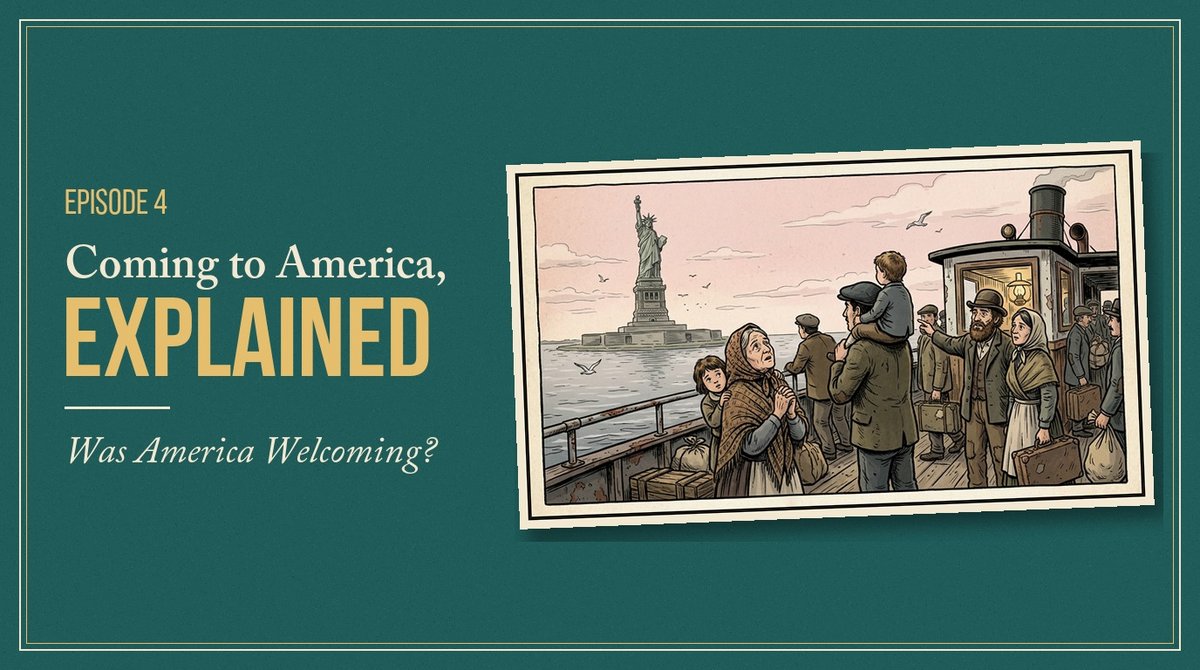
Was America Welcoming?
Episode of the series Coming to America, Explained
- Illustrated slideshow (26 images)
- Glossary (37 words)
- Comprehension quiz (18 questions)
- 15 cultural notes
 Extract · 30 s
The episode
Life for many newcomers was hard: crowded tenements (Riis, 1890: about three in four New Yorkers). Where they came from changed (northern and western Europe in 1882, southern and eastern Europe by 1907, about four million Italians). Some Americans did not want them: 'No Irish need apply' in newspaper job ads (real; the window signs are argued over). Then the laws: the Chinese Exclusion Act of 1882 (Chinese workers barred, no citizenship; permanent 1902; ended 1943, 105 a year), the 1917 reading test, the 1924 quotas (Italy from over 200,000 a year to under 4,000; almost no one from Asia; no limit for the Americas). Twist: Emma Lazarus's poem (1883) went up on a plaque in the pedestal only in 1903.
Episode worksheets (2)
- Student sheet In your teacher account
- Teacher sheet In your teacher account
Teaching guide
Objective & content
Two hosts, one American and one British, ask whether America welcomed the newcomers. They start from the famous lines on the Statue of Liberty, "Give me your tired, your poor, your huddled masses yearning to breathe free", and Alex guesses that the poem went up with the statue in 1886; the answer comes at the end. Learners practise the past simple (counted, wrote, found, forgot, came, gave), could and couldn't for what people were allowed to do, had to for a rule in the past, and When and What questions with did, all on facts of the story. They listen for dates and numbers, then answer the quiz in the app and the one-page pupil sheet. The story follows these beats:
- Life in the tenements, crowded city buildings with many families: in 1890, the writer Jacob Riis wrote that about three in four New Yorkers lived in them.
- A new mix of newcomers: from northern and western Europe in 1882, from southern and eastern Europe by 1907, and about four million Italians in forty years, many in Little Italy.
- Some Americans did not like it, and this was not new: some newspaper job ads said "No Irish need apply" (the first one we know of was in 1842; historians still argue about signs in shop windows).
- The Chinese Exclusion Act of 1882: for ten years Chinese workers could not come in, and Chinese people could not become citizens; it ended in 1943, with only 105 Chinese people a year after that.
- The reading test of 1917 (in the newcomer's own language) and the law of 1924, which gave every country a quota: Italy went from more than two hundred thousand a year to less than four thousand, with no limit for the Americas.
- The answer: Emma Lazarus wrote the poem in 1883, a friend found it in a bookshop in 1901, and it went up on a plaque inside the statue's base in 1903, when the door was already half closed.
The hosts open and close this episode with a short hello and goodbye.
Pedagogical guide
The 45-minute lesson plan starts from the Statue of Liberty and a question: when did the welcome poem go up? Learners guess, listen twice (once for the answer, once with four pauses for questions), then practise facts, vocabulary and the grammar of rules in the past. The two hosts are equals who each bring their own country's view. The laws are told as facts, with their dates and numbers, and the hosts give no verdict: their answer is that America was welcoming for millions of newcomers, but not for everyone, and that both things are true. Keep the lesson on what happened, ask pupils what the laws did rather than what they think of a group of people, and let pupils whose families came from another country share only what they wish. Most activities have a support path and a stretch path.
Suggested procedure
- Activate knowledge (3 min): show the Statue of Liberty and collect guesses about when its welcome poem went up.
- Vocabulary preview (5 min): welcoming, newcomer, tenement, crowded, law, limit, quota, newspaper, worker, poem.
- First listen (8 min): play the whole episode (about 6 minutes 17 seconds, with the theme tune and the hosts' hello) and ask when the poem went up and whether America was welcoming.
- Second listen (10 min): pause four times, after "Many lived near people from home, in Little Italy", after "And about the other new arrivals, from eastern Europe", after "People from Canada, Mexico and the rest of the Americas", and after "But by 1903, the door was already half closed", to ask short questions.
- Comprehension check (5 min): the Facts part of the pupil sheet (questions 1 to 6, as in the app quiz).
- Vocabulary practice (4 min): the Vocabulary part (questions 7 to 12).
- Grammar focus (6 min): complete four facts with could not, had to, couldn't and found, review the past simple and When and What questions with did, then the Grammar part (questions 13 to 18).
- Speaking (4 min): in pairs, students play the two hosts and ask and answer questions about the poem and the laws, ending on the hosts' answer, "Both things are true."
Materials & prerequisites
- The episode in the app, with its quiz.
- The one-page pupil sheet (18 items: facts, vocabulary, grammar) and its answer key, in the episode's printables.
- The two-page differentiated worksheet and its answer key, in the episode's teachers-resources, for homework or a second lesson.
- Prerequisites: the regular past simple, was and were, years and large numbers in English, and can and can't.
Possible adaptations
- Lower levels: Offer segmented listening and additional visual aids.
- Advanced levels: Encourage an oral summary and a debate in English on the theme.
- Large groups: Organise group work with differentiated roles.
🔒 Restricted content
This resource requires a subscription to be viewed.
Unlock the resourceIncluded in the subscriptionTags
- Documentary
- Past simple: regular verbs
- Past simple: irregular verbs
- Past simple: was / were
- Modals in the past
- Wh- questions
- Negation: do / does / did
- Immigration
- Historical dates
- Large numbers
- Government
- Society & politics
- The USA: basics
- New York
- Travel and migration
- Encountering others
- Listening comprehension
- Cultural awareness
- Vocabulary building
- Home, culture & migration
- Arriving & belonging
- Citizenship & society
- Belonging & Home
- Our World