Did They Stay, and Who Came Next?
Episode of the series Coming to America, Explained
- Illustrated slideshow (27 images)
- Glossary (33 words)
- Comprehension quiz (18 questions)
- 16 cultural notes
 Extract · 30 s
The episode
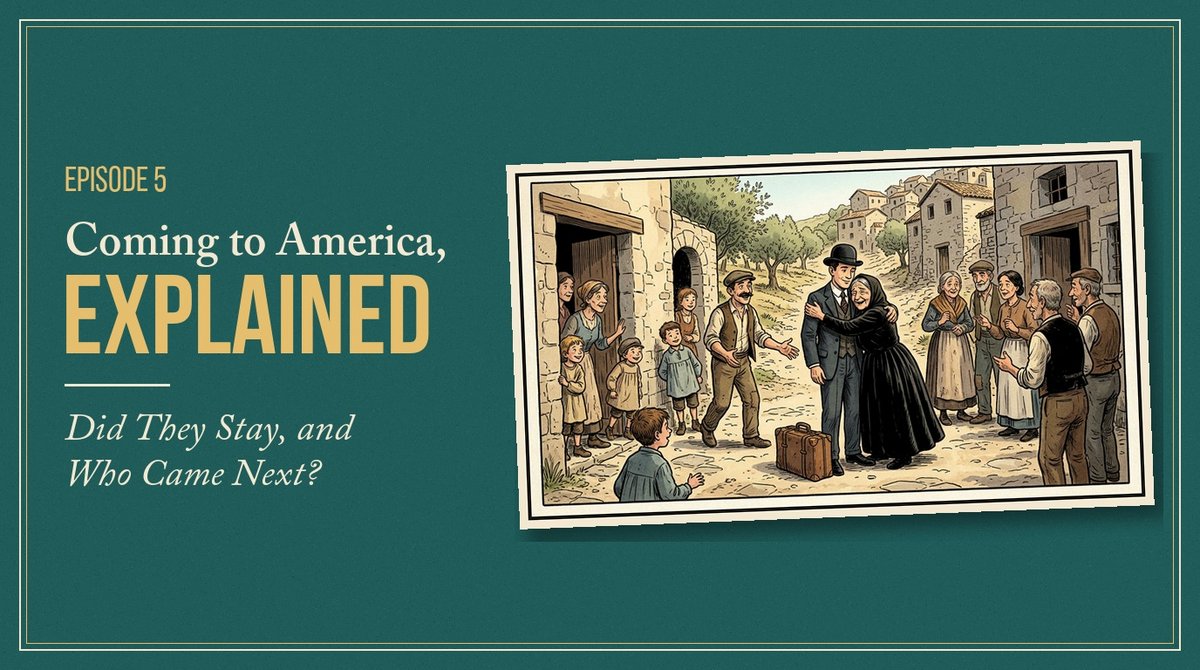
Many newcomers went home: Italian 'birds of passage' (from about one in four to more than half by different estimates; 73 in 100 in 1907-1911 by one count); Jewish families from the Russian Empire mostly stayed. About a third of Americans or more have an Ellis Island ancestor. What stayed: pizza (Lombardi's, often called the first, 1905), words (bagel, kindergarten, chutzpah), the St Patrick's Day parade (1760s, older than the country). Who came next: in 1848 a treaty moved the border (about half of Mexico's land; about 80,000 Mexicans had a year to choose); from the 1910s, and above all in the 1920s, Mexicans went north to farms and railways (as many as 600,000 legal arrivals in the 1920s); the 1924 law set no quota for the Americas.
Episode worksheets (2)
- Student sheet In your teacher account
- Teacher sheet In your teacher account
Teaching guide
Objective & content
Two hosts, one American and one British, ask what happened to the newcomers after they arrived in America, and who came next. Sam's first answer, that you bring your family over and you stay, is only half right: many people bought a ticket home. Learners practise the past simple (came, went, bought, lost, found), negatives with didn't (they didn't move), comparing (older than, bigger and bigger) and questions with How many and What did, on facts of the story; the lesson plan adds the present simple for word meanings, which the script also uses (bagel comes from Yiddish). They listen for numbers, places and dates, then answer the quiz in the app and the one-page pupil sheet. The story follows these beats:
- Many Italian newcomers planned to work for a few years and go back (historians call them birds of passage); the books give different numbers for how many went home, from about one in four to more than half.
- Many Jewish families from the Russian Empire came to stay, and very few went back; today about a third of Americans, or even more, have a great-grandparent who came through Ellis Island.
- What stayed: pizza (Lombardi's in New York, from 1905, is often called the first pizzeria, but historians aren't sure), words from Yiddish and German (bagel, chutzpah, kindergarten) and the New York Saint Patrick's Day parade, which is older than the United States.
- Who came next: the 1924 law gave every country a limit, but no limit for people from the Americas.
- 1848: after a war, the United States and Mexico signed a treaty and Mexico lost about half of its land; gold was found in California, and people rushed in from Chile, Europe and China.
- About eighty thousand Mexicans had one year to choose, and most stayed and became Americans, on paper at least: they didn't move, the border moved.
- After 1910, a revolution and a new railway sent many Mexicans north to work on farms and railways. The twist: many Europeans went home, and when the Atlantic door was almost shut, the door from the south stayed open.
The hosts open this episode with a short hello and close the series with a goodbye.
Pedagogical guide
The 45-minute lesson plan starts from the hosts' own question: you cross the ocean, you find work and save money, then what? Learners guess, listen twice (once for the answer, once with four pauses for questions), then practise facts, vocabulary and the grammar of telling a story. The two hosts are equals who each bring their own country's view, so the class can say which foods or words came to their own country from somewhere else. The war of 1848 is named once and not described, and the hosts' modern saying is about 1848: keep the talk on what happened then, and do not open a debate about immigration today. The idea to repeat is the hosts' answer: many came, some went home, many stayed, and the door from the south stayed open. Most activities have a support path and a stretch path.
Suggested procedure
- Activate knowledge (3 min): ask the hosts' question (you cross the ocean, you find work, you save money: then what?) and collect guesses.
- Vocabulary preview (5 min): ticket, historian, newcomer, parade, border, treaty, land, gold, railway, farm.
- First listen (8 min): play the whole episode (about 5 minutes 55 seconds, with the theme tune and the hosts' hello) and ask whether all the newcomers stayed.
- Second listen (10 min): pause four times, after "Whole families came together, and very few went back", after "And with all the Irish newcomers, it got bigger and bigger", after "The border crossed us", and after "In the 1920s alone, as many as six hundred thousand Mexicans came", to ask short questions.
- Comprehension check (5 min): the Facts part of the pupil sheet (questions 1 to 6, as in the app quiz).
- Vocabulary practice (4 min): the Vocabulary part (questions 7 to 12).
- Grammar focus (6 min): the past simple of irregular verbs, didn't with the base verb, older than, and How many and What did questions, then the Grammar part (questions 13 to 18).
- Speaking (4 min): in pairs, students play the two hosts and ask and answer questions about who stayed, what stayed and who came next, ending on the hosts' last three sentences.
Materials & prerequisites
- The episode in the app, with its quiz.
- The one-page pupil sheet (18 items: facts, vocabulary, grammar) and its answer key, in the episode's printables.
- The differentiated worksheet (vocabulary, comprehension, grammar) and its answer key.
- Prerequisites: the regular past simple, was and were, years in English, and the connectors so and but.
Possible adaptations
- Lower levels: Offer segmented listening and additional visual aids.
- Advanced levels: Encourage an oral summary and a debate in English on the theme.
- Large groups: Organise group work with differentiated roles.
🔒 Restricted content
This resource requires a subscription to be viewed.
Unlock the resourceIncluded in the subscriptionTags
- Documentary
- Past simple: regular verbs
- Past simple: irregular verbs
- Past simple: was / were
- Comparatives: short adjectives
- Wh- questions
- Negation: do / does / did
- Immigration
- Historical dates
- Large numbers
- Family
- Food & drinks
- New York
- St Patrick's Day
- Travel and migration
- Encountering others
- Listening comprehension
- Cultural awareness
- Vocabulary building
- Home, culture & migration
- Modern history
- Belonging & Home
- Past & Progress