Why Did Millions Leave Europe?
Episode of the series Coming to America, Explained
- Illustrated slideshow (37 images)
- Glossary (29 words)
- Comprehension quiz (18 questions)
- 22 cultural notes
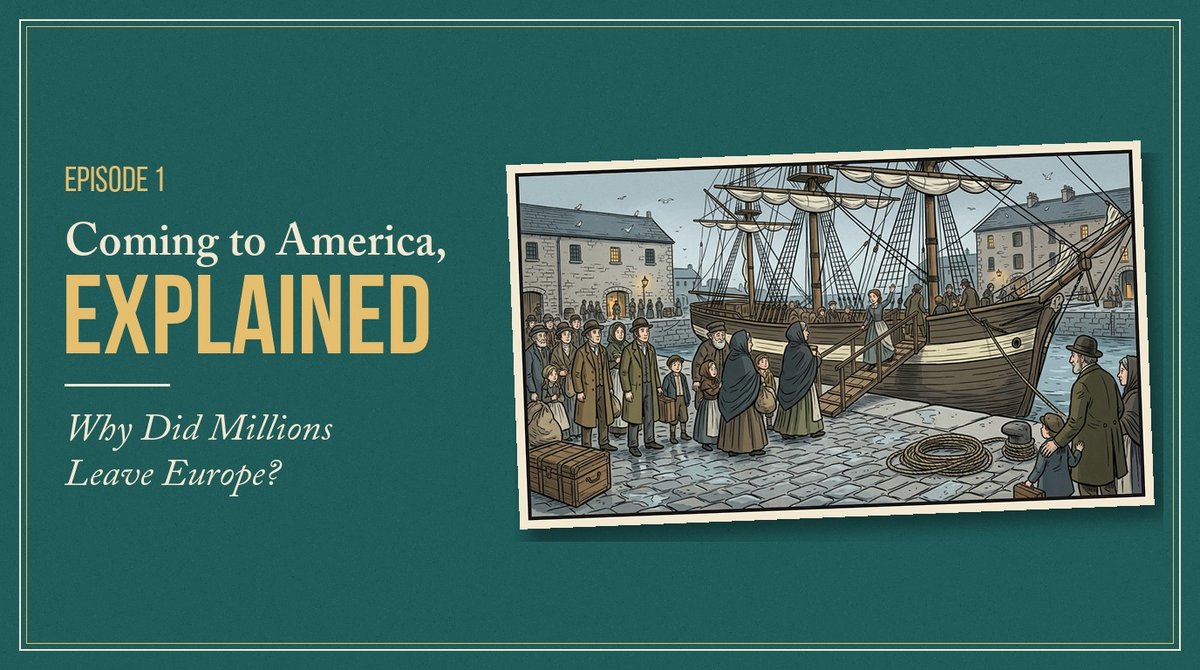 Extract · 30 s
The episode
Between the 1840s and the 1910s, more than thirty million Europeans went to the United States, one of the biggest movements of people in history. Hunger, poverty, no land, no work and persecution pushed them out (the Irish famine, when Ireland was part of the United Kingdom; landless farmers in the south of Italy; Jewish families in the Russian Empire); jobs, land and freedom pulled them to America. The surprise is how the poorest paid for the crossing: very often, family already in America sent the money or a ticket.
Episode worksheets (2)
- Student sheet In your teacher account
- Teacher sheet In your teacher account
Teaching guide
Objective & content
Two hosts, one American and one British, start from a puzzle: how did a poor farmer in Ireland pay for a ticket to America? Sam's guess is that he saved for years or sold his cow, but very often somebody else paid. To answer, the hosts explain the movement with two words, push and pull. The push: the potato disease and the Great Famine in Ireland, more than two million people from England and Scotland (the "invisible immigrants"), Italian farmers with no land, and Jewish families in the Russian Empire who faced attacks and unfair laws. The pull: factories, railways and mines that needed workers, cheap tickets, and the Homestead Act of 1862 with its free land in the west. The answer to the puzzle is a letter: a real letter from 1850, written by a young Irish woman in America to her parents in Cork, with twenty dollars inside, and the chain of brothers, sisters and cousins that followed. Learners practise the past simple (attacked, came, left, sent, wrote), comparing (the biggest movements) and Why and How questions with did; the lesson plan and the pupil sheet add the link words because, so and but, before and after, and who and which, on facts of the story. They listen for numbers and places, then answer the quiz in the app and the one-page pupil sheet.
Pedagogical guide
The 45-minute lesson plan starts from the puzzle: how did a poor farmer pay for a ticket to America? Learners guess, listen twice (once for the answer, once with four pauses for questions), then practise facts, vocabulary and the grammar of explaining. The two hosts are equals who each bring their own country's view, so the class can discuss what a pupil's own country would add. The Great Famine, the enslaved Africans brought to America by force and the attacks on Jewish families are told briefly and factually: keep the talk on the facts and on why people left. The idea to repeat is the hosts' last sentence: the push was at home, and the pull was a job, some land and a letter with money in it. Most activities have a support path and a stretch path.
Suggested procedure
- Activate knowledge (3 min): write a ticket to America on the board and collect guesses about how a poor farmer paid for it.
- Vocabulary preview (5 min): ticket, disease, factory, railway, land, worker, push, pull.
- First listen (8 min): play the whole episode (about 6 minutes 10 seconds, with the theme tune and the hosts' hello) and ask whether the guesses were right.
- Second listen (10 min): pause four times, after "Other things pulled them to America", after the famine figures, after the summary of the push, and after "Very often, the money came from America", to ask short questions.
- Comprehension check (5 min): the Facts part of the pupil sheet (questions 1 to 6, as in the app quiz).
- Vocabulary practice (4 min): the Vocabulary part (questions 7 to 12).
- Grammar focus (6 min): join facts with because, but, so, after and before, notice who and which, review the past simple, then the Grammar part (questions 13 to 18).
- Speaking (4 min): in pairs, students play the two hosts and ask and answer questions with Why and How, ending on the hosts' last two sentences.
Materials & prerequisites
- The episode in the app, with its quiz.
- The one-page pupil sheet (18 items: facts, vocabulary, grammar) and its answer key, in the episode's printables.
- Prerequisites: the regular past simple, was and were, years in English, and the connectors so and but.
Possible adaptations
- Lower levels: Offer segmented listening and additional visual aids.
- Advanced levels: Encourage an oral summary and a debate in English on the theme.
- Large groups: Organise group work with differentiated roles.
🔒 Restricted content
This resource requires a subscription to be viewed.
Unlock the resourceIncluded in the subscriptionTags
- Documentary
- Past simple: regular verbs
- Past simple: irregular verbs
- Past simple: was / were
- Logical connectors
- Wh- questions
- Superlatives
- Relative pronouns
- Immigration
- Countries
- Historical dates
- Large numbers
- American Dream
- Travel and migration
- Listening comprehension
- Cultural awareness
- Vocabulary building
- Home, culture & migration
- World cultures
- Exploring America
- Belonging & Home
- Places & Journeys