How Did They Get There?
Episode of the series Coming to America, Explained
- Illustrated slideshow (29 images)
- Glossary (29 words)
- Comprehension quiz (18 questions)
- 24 cultural notes
 Extract · 30 s
The episode
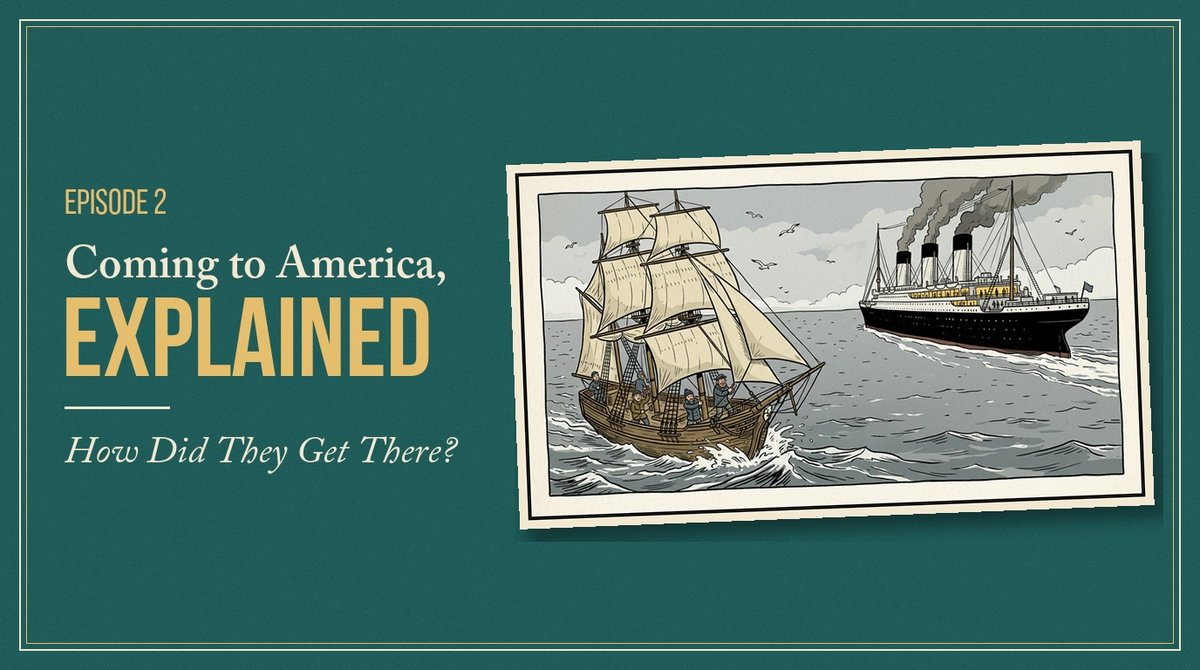
Between the 1840s and the 1910s, millions of emigrants crossed the Atlantic, most from Liverpool (about nine million between 1830 and 1930), the Irish also from Cobh (Queenstown) and the Germans from Hamburg and Bremen. Most travelled in steerage, the cheapest ticket, below deck, with simple food, and laws slowly set rules for space and air. Steam replaced sail: the crossing fell from five or six weeks to less than two weeks by the 1870s and about eight days by 1910. The surprise: the ticket did not get cheaper. What fell was the time, and, against wages, the cost.
Episode worksheets (2)
- Student sheet In your teacher account
- Teacher sheet In your teacher account
Teaching guide
Objective & content
Two hosts, one American and one British, ask how millions of emigrants crossed the Atlantic, and why the same trip took about forty days in 1853 and only about eight in 1913. Sam guesses that the ticket got cheaper too; that is the surprise of the story. Learners practise the past simple (grabbed, took, led, built, paid), comparing (cheaper, faster, shorter, better, more) and What and Why questions with did; the lesson plan and the pupil sheet add the link words because, so and but, and who, which and where, on facts of the story. They listen for numbers, places and prices, then answer the quiz in the app and the one-page pupil sheet. The story follows these beats:
- The port of Liverpool, where about nine million people sailed from, and the docks, where men called runners grabbed the newcomers' bags and asked for money.
- Steerage: the cheapest ticket, below the deck, with rows of beds and not much air; the famine-year ships are mentioned once, soberly.
- From sail (five or six weeks, because a sailing ship needs wind) to steam (less than two weeks by the 1870s, and regular).
- The German company HAPAG, which built a small town for its emigrants in Hamburg, with doctors, because of an American law of 1891.
- The Titanic's third class: more than half of its passengers, small cabins and a dining room; its sinking is stated once, factually.
- The answer to the surprise: the price went up, but a long trip meant weeks with no work and pay went up, so a ticket cost about eleven weeks of a British worker's pay in the 1850s and about seven before 1914. Steam was not cheaper, it was faster.
The hosts open and close this episode with a short hello and goodbye.
Pedagogical guide
The 45-minute lesson plan starts from two numbers: forty days and eight days for the same trip. Learners guess what changed, listen twice (once for the answer, once with four pauses for questions), then practise facts, vocabulary and the grammar of explaining. The two hosts are equals who each bring their own country's view, so the class can discuss which port people left from in their own country. The runners, the famine-year ships and the sinking of the Titanic are told briefly and factually: keep the talk on the facts and on how the trip changed, and do not ask pupils to imagine the suffering. The idea to repeat is the hosts' answer: steam was not cheaper, it was faster. Most activities have a support path and a stretch path.
Suggested procedure
- Activate knowledge (3 min): write forty days and eight days on the board and collect guesses about what changed and whether the ticket got cheaper.
- Vocabulary preview (5 min): ticket, price, pay, passenger, cabin, engine, wind, law.
- First listen (8 min): play the whole episode (about 5 minutes 50 seconds, with the theme tune and the hosts' hello) and ask whether the guesses were right.
- Second listen (10 min): pause four times, after "People called them land sharks", after "With no wind, it was very slow", after "But by then, most crossings took only about eight days", and after "In fact, it went up", to ask short questions.
- Comprehension check (5 min): the Facts part of the pupil sheet (questions 1 to 6, as in the app quiz).
- Vocabulary practice (4 min): the Vocabulary part (questions 7 to 12).
- Grammar focus (6 min): join facts with so, but and because, notice who, which and where, review the past simple and comparing, then the Grammar part (questions 13 to 18).
- Speaking (4 min): in pairs, students play the two hosts and ask and answer questions about the two numbers and the ticket, ending on the hosts' last three sentences.
Materials & prerequisites
- The episode in the app, with its quiz.
- The one-page pupil sheet (18 items: facts, vocabulary, grammar) and its answer key, in the episode's printables.
- Prerequisites: the regular past simple, was and were, years in English, and the connectors so and but.
Possible adaptations
- Lower levels: Offer segmented listening and additional visual aids.
- Advanced levels: Encourage an oral summary and a debate in English on the theme.
- Large groups: Organise group work with differentiated roles.
🔒 Restricted content
This resource requires a subscription to be viewed.
Unlock the resourceIncluded in the subscriptionTags
- Documentary
- Past simple: regular verbs
- Past simple: irregular verbs
- Past simple: was / were
- Negation: do / does / did
- Comparatives: short adjectives
- Comparatives: long / irregular
- Superlatives
- Logical connectors
- Wh- questions
- Transport
- Immigration
- Historical dates
- Large numbers
- Travel and migration
- Listening comprehension
- Cultural awareness
- Vocabulary building
- Travel & transport
- Home, culture & migration
- Modern history
- Places & Journeys
- Belonging & Home
- Past & Progress