Space, Part 1: To the Moon
Episode of the series Awesome Stuff
- Illustrated slideshow (29 images)
- Glossary (18 words)
- Comprehension quiz (17 questions)
- 20 cultural notes

 Extract · 30 s
The episode
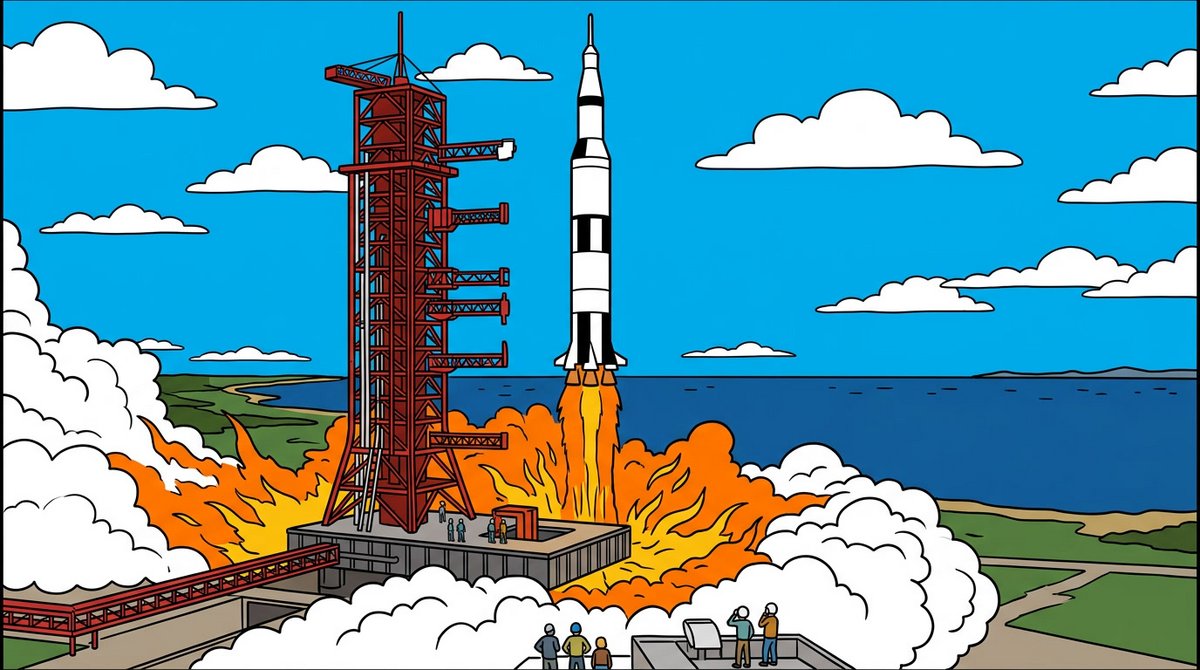
Three, two, one, lift-off! Find out how three American astronauts flew to the Moon in 1969, and why their footprints are still there today.
Episode worksheets (2)
- Student sheet In your teacher account
- Teacher sheet In your teacher account
Teaching guide
Objective & content
Two friends talk about America's trip to the Moon: NASA, America's space agency, which started in 1958, and its astronauts; the rockets that go up from the Kennedy Space Center in Florida; the Saturn V Moon rocket, taller than the Statue of Liberty; and July 1969, when Neil Armstrong walked on the Moon first, Buzz Aldrin next, and Michael Collins took care of the spaceship. The friends explain the famous words "one small step for man, one giant leap for mankind" in simple English, and why the footprints are still on the Moon today. The 1969 story is told in the past simple (went, flew, walked, stayed), for learners to recognise rather than produce; what is true today is in the present simple (the rockets go up, there's no air on the Moon), with was, can (Can people watch?), a short comparative (taller than) and questions (How many people walked on the Moon?). Learners listen for the three astronauts, the numbers and the dates, then answer the quiz in the app.
Materials & prerequisites
- The episode in the app, with its quiz.
- Prerequisites: present simple, there is / there's no, can, was and saying years and big numbers in English.
Curriculum alignment
Tagged c3-child-and-wider-environment and people-and-characters, so it fits cycle 3 (6e) and the 6e axis People and characters ("Personnes et personnages"). It also fits the USA and famous people topics of German Klasse 6 and 7. The episode targets CEFR A1+.
Possible adaptations
- Lower levels: Offer segmented listening and additional visual aids.
- Advanced levels: Encourage an oral summary and a debate in English on the theme.
- Large groups: Organise group work with differentiated roles.
🔒 Restricted content
This resource requires a subscription to be viewed.
Unlock the resourceIncluded in the subscriptionTags
- Podcast
- Past simple: irregular verbs
- Past simple: regular verbs
- Past simple: was / were
- Present simple
- There is / there are
- Comparatives: short adjectives
- Can: permission
- Question forms
- Space exploration
- Famous people
- Size & shape
- The USA: basics
- Famous explorers
- Child and wider environment
- People and characters
- Listening comprehension
- Cultural awareness
- Vocabulary building