Zusammengefasst
Klassenstufe :Klasse 6
Art :Hörbücher
Kulturelle Schwerpunkte :Personen & Charaktere, Alltag, Länder & Landschaften, Legenden & Fantastisches


 y
y
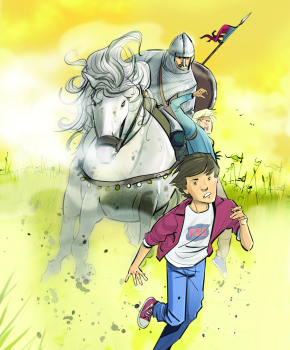
What if a history lesson became as intense as a video game? "Harry at Hastings" plunges students into a fantastic adventure where the past becomes reality. This audio story follows a teenager who hates history until he finds himself thrown right into the middle of the Battle of Hastings! It's a dynamic and action-packed resource to captivate students, linking a major historical event to a time-travel adventure and unexpected friendship.
Klassenstufe :Klasse 6
Art :Hörbücher
Kulturelle Schwerpunkte :Personen & Charaktere, Alltag, Länder & Landschaften, Legenden & Fantastisches
Sonderangebot für Early-Bird-Anmeldungen. Schalten Sie diese Ressource frei, indem Sie Ihre Schülerinnen und Schüler jetzt für den Wettbewerb anmelden, und profitieren Sie von unseren exklusiven Vorteilen!
Ziel & Zusammenfassung der Handlung
Ziel: Die Schüler sollen einer fantastischen Abenteuergeschichte folgen und dabei die Schlüsselpunkte eines einfachen historischen Ereignisses (die Schlacht von Hastings) sowie die Entwicklung der Beziehung zwischen zwei Charakteren verstehen.
Zusammenfassung: Harry, ein Schüler, der Geschichte hasst, wird zusammen mit seinem "Streber"-Kameraden Adam während eines Schulausflugs mitten in die Schlacht von Hastings von 1066 katapultiert. Von normannischen Soldaten gefangen genommen, müssen die beiden gegensätzlichen Jungen zusammenhalten, um zu überleben und in ihre eigene Zeit zurückzukehren.
Vorgeschlagener Ablauf
1. Vor dem Hören (~5-10 Min.): DIE SCHLACHT VORBEREITEN
Antizipation: Den Kontext vorstellen: ein Schulausflug zu einem historischen Schlachtfeld. "Do you like school trips? Do you like history?".
Vokabular: Schlüsselwörter der Schlacht mit Bildern einführen: battle, soldier, king, arrow (Pfeil), sword (Schwert).
2. Während des Hörens (~25 Min.): ZEITREISE
Fragmentiertes Hören in 3 Phasen:
Teil 1 (Der Schulausflug): Den Anfang hören, der die Gegensätzlichkeit zwischen Harry und Adam darstellt. Pause: "Who likes history? Who likes video games? Are they friends?".
Teil 2 (In der Vergangenheit): Den Sturz in die Vergangenheit und ihre Gefangennahme hören. Pause: "Where are they now? What year is it? What is the problem?".
Teil 3 (Die Rückkehr): Die Rettung von Adam und ihre Rückkehr in die Gegenwart hören.
3. Nach dem Hören (~10-15 Min.): RÜCKKEHR IN DIE GEGENWART
Diskussion: "Was the adventure real? How do we know? Did Harry change at the end of the story? Why?".
Einfache Aufgabe: Die Schüler bitten, eine Figur (Harry oder Adam) zu wählen und in einem einfachen Satz zu sagen, was sie mögen. ("Harry likes video games." / "Adam likes books and history.").
Anpassungen
Zur Vereinfachung: Vor dem Hören den Kontext der Schlacht sehr kurz erklären: "In 1066, two armies, the Saxons and the Normans, fight in a big battle".
Zur Vertiefung: Die Schüler fragen: "If you can travel in time, where do you go? To the past or to the future? Why?". Die Schüler antworten in ein oder zwei Sätzen.
break ranks: when an army breaks ranks, it is not in battle formation
cancel (v): to stop
chainmail (n.): metal protection worn by knights
complain (v.): to say that you don’t like something
desert (v.): to abandon, to leave behind
fist (n.): you make a fist with your hand when you want to hit someone
gap (n.): a hole, a space
glance off (v.): to hit and then move away
go off (v.): (here) to begin to make a noise
grab (v.): to seize, to take something quickly
groan (v.): to make a noise to show you are not happy
invade (v.): to attack and take control (of a country)
let go (v.): to release
nod (v.): to move your head up and down to say “yes” (I’m) out of here: I’m leaving
retreat (v.): to return, to pull back troops
rope (n.): a cord
salary (n.): your salary is the money you are paid when you work
show off (n.): a person who likes to show that he/she is better than others
snore (v.): to make a noise when you sleep
spear (n.): a lance
spy (n.): an enemy looking for information
sword (n.): a very long knife; before there were guns, soldiers used swords in battle
tapestry (v.): a piece of cloth with pictures on it
tax (v.): (here) the money that you pay to the King
teacher’s pet (n.): the teacher’s favourite pupil
tie (v.): to attach with a rope / untie (v.): to remove the ropes
tiptoe (v.): to walk on your toes quietly
trick (n.): (here) a ruse
warrior (n.): a fighting man, a soldier
Please wait...

