Zusammengefasst
Klassenstufe :Klasse 6
Art :Hörbücher
Kulturelle Schwerpunkte :Personen & Charaktere, Alltag, Länder & Landschaften, Legenden & Fantastisches


 y
y
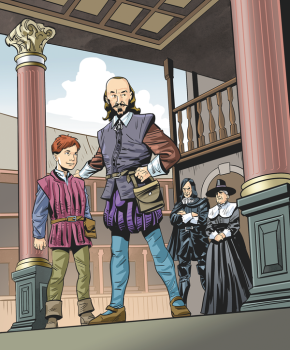
Transport your students to the bustling London of Shakespeare with this captivating historical mystery! "Shakespeare and the Shoemaker" is an audio story that blends adventure, mystery, and culture. Students will follow Edmund, a clever young hero who uses his unique talent to solve an investigation. It is an excellent resource for working on aural comprehension of a suspenseful plot, while also discovering the world of the greatest English playwright.
Klassenstufe :Klasse 6
Art :Hörbücher
Kulturelle Schwerpunkte :Personen & Charaktere, Alltag, Länder & Landschaften, Legenden & Fantastisches
Um dieses Material herunterzuladen, müssen Sie mit Ihrem Lehrkräfteaccount eingeloggt und für den Big Challenge-Wettbewerb angemeldet sein.
Ziel & Zusammenfassung der Handlung
Ziel: Die Schüler dazu anleiten, eine Untersuchung auf Englisch zu verfolgen, Verdächtige anhand von akustischen Hinweisen zu identifizieren und die Lösung eines Rätsels zu verstehen.
Zusammenfassung: Im London des 16. Jahrhunderts trifft ein junger Schusterlehrling mit fotografischem Gedächtnis seinen Helden, William Shakespeare. Als das Ende von Romeo und Julia bei einem verdächtigen Brand zerstört wird, setzt Edmund seine List und sein Talent ein, um den Schuldigen unter drei Verdächtigen zu überführen und das Stück zu retten.
Vorgeschlagener Ablauf
1. Vor dem Hören (~10 Min.): EIN TAUCHGANG INS LONDON DES 16. JAHRHUNDERTS
Antizipation: Zeigen Sie die Abbildung der Figuren und der Karte (Seite 3). Wer ist Shakespeare? Wo spielt die Handlung?
Vokabular: Führen Sie die Wörter der Untersuchung ein: fire, suspect, guilty (schuldig), trap (Falle).
2. Während des Hörens (~25 Min.): DER SPUR FOLGEN
Gliedertes Hören in 3 Abschnitten:
Teil 1 (Die Verdächtigen): Hören Sie bis zum Ende der Besuche von Greenaway, Benson und Hardcastle. Pause: „Who is angry at Shakespeare? Why?“.
Teil 2 (Das Verbrechen): Hören Sie bis zur Entdeckung der Brandstiftung. Pause: „What happened? Who are the three suspects?“.
Teil 3 (Die Lösung): Hören Sie Edmunds Plan und die Auflösung.
3. Nach dem Hören (~15 Min.): DEN FALL LÖSEN
Diskussion: „Who was the guilty person? Why did he do it? Was Edmund's plan clever?“.
Einfache Aufgabe: Bilden Sie 3 Gruppen, eine für jeden Verdächtigen. Jede Gruppe bereitet einen Satz vor, um ihre Unschuld zu beteuern oder einen anderen zu beschuldigen. Beispiel: „I am Dame Hardcastle. I am not guilty. I think the actor did it!“.
Anpassungen
Zur Vereinfachung: Erstellen Sie an der Tafel eine „Verdächtigen“-Karte. Machen Sie nach dem Anhören der Vorstellung jedes Verdächtigen eine Pause und notieren Sie dessen Namen und den Grund für seine Wut (das Motiv).
Zur Vertiefung: Bitten Sie die Schüler, sich vorzustellen, Shakespeare zu sein. Sie schreiben eine kurze Notiz in ihr Tagebuch, um von dem Brand und ihrer Begegnung mit dem „bemerkenswerten“ Edmund zu erzählen.
absent-minded (adj.) If you are absent-minded, you often forget things.
absurd (adj.) without any meaning an afternoon off an afternoon when you don’t have to work
apprentice (n., v.) an apprentice is a young person who is learning a specific job from an older, experienced person
ashes (n.) what is left of wood, paper or coal after a fire
astounded (adj.) extremely surprised be on the throne A King or a Queen sits on a throne.
blank (adj.) with no writing on
bright (adj.) clever, intelligent, quick to learn
can’t stand (v.) If you can’t stand something, you hate it!
cloth (n.) material (cotton, wool, etc.)
constable (n.) in the 16th century, a sort of policeman
corridor (n.) a passage between two rooms, for example
crypt (n.) a room underneath a church where people are buried
dagger (n.) a sort of knife
deliver (v.) If you buy something on the Internet, someone will deliver it to your house.
devil (n.) an evil force or person, the opposite of God do harm to hurt, to cause problems for
edge (n.) the outside limit of something
entertain (v.) to amuse, to give pleasure to get their way to obtain what they want
guilty (adj.) responsible (for a crime)
Heaven (n.) Paradise
leather (n.) the skin of an animal (usually a cow) used for clothes, shoes or bags, for example
magistrate (n.) a judge
manuscript (n.) a text that someone wrote by hand
orphanage (n.) a home for children without parents
part (n.) (here) role in a play or a film
playwright (n.) a person who writes plays
Puritan (n.) The Puritans were a group of English Protestants in the 16th and 17th centuries who wanted to impose strict rules on people’s lives.
rubbish (n.) something with no value, something you throw away run errands to take messages, go shopping, etc.
sheet (n.) A sheet of paper is a large piece of paper – a page.
sigh (v.) When you sigh, you make a soft sound, like “Aaah”.
stage door (n.) The stage is where the actors perform. The back door of a theatre, used by the people who work in the theatre, is the stage door.
storm out (v.) to leave quickly and angrily
suspect (n.) a person you think is responsible for a crime
tear up (v.) to pull apart with force
threaten (n.) to menace, to intimidate
trap (n.) a trick to make someone do something they don’t intend to do
triumphantly (adv.) in a way that shows victory
trust (v.) to have confidence in
ungodly (adj.) against the rules made by God
useless (n.) If something is useless, it doesn’t work or is impossible to use.
warn (v.) to inform someone in advance of a possible danger
widower (n.) a man whose wife is dead
Please wait...