Going to a Football Match
Episode of the series Great Stuff
- Illustrated slideshow (21 images)
- Glossary (13 words)
- Comprehension quiz (17 questions)
- 17 cultural notes

 Extract · 30 s
The episode
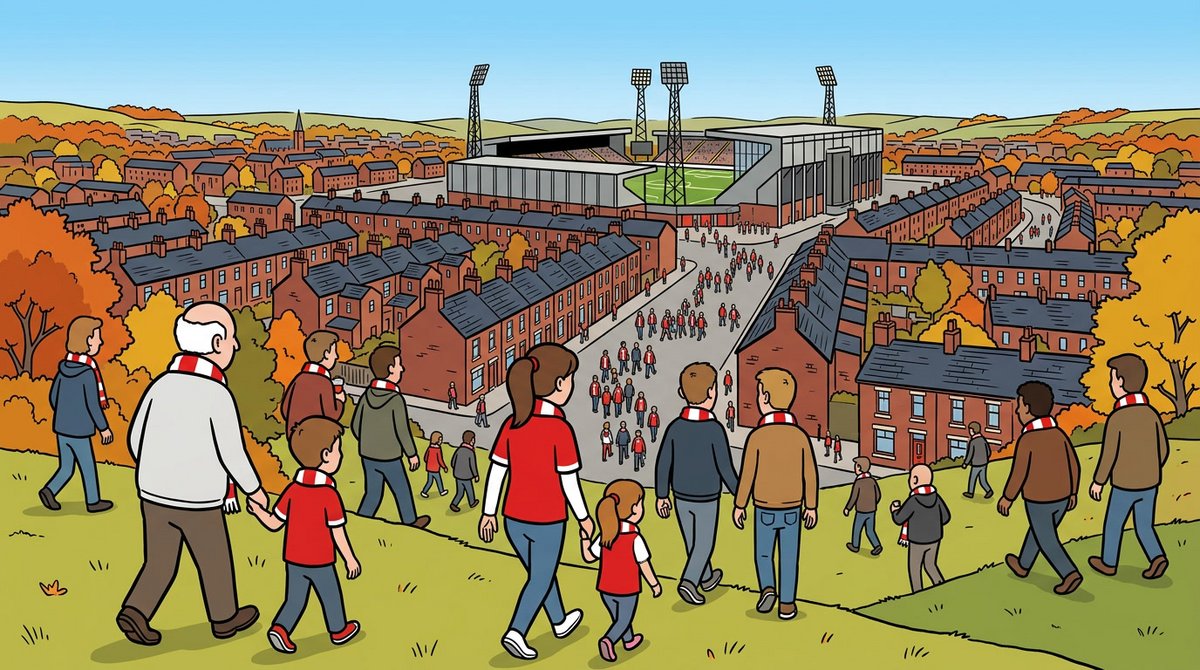
A scarf, a crowd that sings and a hot pie at half-time: two friends spend a Saturday afternoon at a British football match and find out where the game's first rules come from.
Episode worksheets (2)
- Student sheet In your teacher account
- Teacher sheet In your teacher account
Teaching guide
Objective & content
This A1+ documentary, "Going to a Football Match", is a dialogue between two friends who spend a Saturday afternoon at a football match in Britain, from the team's scarf to the walk home, with a short line on where football's first rules come from (London, 1863). The main language points are the present simple, there is, instructions with the imperative ("Stand up and sing!") and the present continuous for now. The skill is listening: learners put the afternoon in order, then take the in-app quiz.
Pedagogical guide
The episode explains its own football words: the ground is "the place with the grass and the seats", kick-off is "the start of the match", half-time is "the break in the middle", nil means zero and a draw is when the two teams have the same score. Fan, scarf, crowd, goal and pie are above A1 in the dictionary, and queue ("It's a queue", after "a very long line") is B1, but they name the subject; teach them for recognition, with a picture. The team, its red and white colours and the ground are invented: no real club, player or song is named.
Suggested procedure
- Pre-listening (8 min): ask where learners play or watch football, then preview eight words with pictures.
- First listen (4 min): the whole audio (about 3 minutes 25 seconds): what day is it, and what is the score at the end?
- Second listen (9 min): pause at 1:22, 1:51, 2:27 and 2:53 and put six afternoon cards in order, from the scarf to the walk home.
- Comprehension check (5 min): the six Facts questions of the episode quiz.
- Vocabulary practice (3 min): name the picture, or questions 7 to 12 of the student sheet.
- Grammar focus (5 min): the instructions of the match ("Stand up and sing!"), then what is happening now.
- Speaking extension (4 min): in pairs, a fan explains the match to a friend at their first game.
- Optional writing (2 min): three sentences about a match or a game in the learners' town.
Adaptations
Support: give the six afternoon cards as a word bank, keep the pictures on the board during both listens, and ask questions 1 to 3 as multiple choice. Stretch: no pictures in the second listen, and one sentence from the episode for each card.
Materials & prerequisites
- Student sheet and teacher sheet (HTML and PDF versions of each), from the episode's printables.
- The episode audio (about 3 minutes 25 seconds) in the app or as a file.
- Six afternoon cards for the board; pictures from the episode slideshow (optional).
Curriculum alignment
Cycle 3 (6e): the child and the close environment and the child and the wider environment, with the 6e axis "Le quotidien : vivre, jouer, apprendre" and the 6e theme of hobbies and sports. No unit of the three 6e textbooks covers a British football match; On Your Marks Unit 4 "Game On!" (sport in English-speaking nations) is the nearest. CEFR target: A1+.
Possible adaptations
- Lower levels: Offer segmented listening and additional visual aids.
- Advanced levels: Encourage an oral summary and a debate in English on the theme.
- Large groups: Organise group work with differentiated roles.
🔒 Restricted content
This resource requires a subscription to be viewed.
Unlock the resourceIncluded in the subscriptionTags
- Documentary
- Present simple
- There is / there are
- Imperatives
- Present continuous
- Question forms
- Sports
- Free time
- Food & drinks
- Football
- Child and close environment
- Child and wider environment
- Listening comprehension
- Vocabulary building
- Cultural awareness