S1E05 - We Don't Light Candles
Episode of the series Golden Bay
- Illustrated slideshow (47 images)
- Glossary (20 words)
- Comprehension quiz (15 questions)

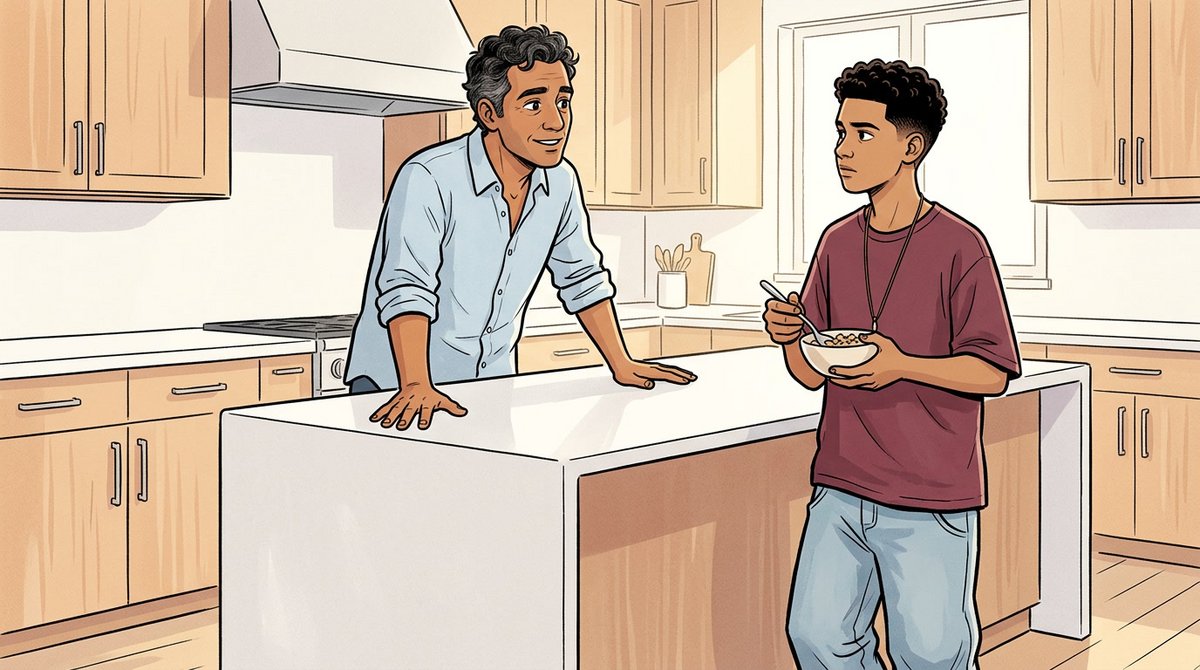
 Extract · 30 s
The episode
Tiago finds the one thing that's truly his in his new home — skating — but a strange, growing fear about fire and candles suggests his stepmother is hiding something about his arrival.
Episode worksheets (2)
- Student sheet In your teacher account
- Teacher sheet In your teacher account
Teaching guide
Objective & content
In this episode, Tiago's father Rodrigo signs him up for a soccer league because he assumes every Brazilian boy plays, and Tiago answers "Everyone thinks Brazilians play soccer. I don't. I skate." Mason understands what skating gives him, then at dinner Tiago mentions his grandfather's birthday candles and Diane answers sharply: "We don't do candles here." When Tiago says it was just a story, she adds: "We don't light candles in this house." Stella notices that her mother's fear of fire is recent, and that it started around the time Tiago arrived. The language focus is the present simple for habits and house rules, with negatives ("We don't light...") and questions ("What do you miss?"). Vocabulary covers family, home, sports and feelings; learners practise listening comprehension, then the in-app quiz.
Pedagogical guide
This 45-minute lesson for a 4eme class (A2+) consolidates the present simple after four earlier episodes: statements, negatives and questions are sorted from the script. The episode closes Module 1 and leaves the candle mystery open on purpose. Do not explain why Diane reacts this way; Stella's remark is a clue, not something to confirm. Stereotypes about a country are the entry point, and the words candle and weird are worth pre-teaching because they carry the key scene. Support ([S]) and extension ([A]) options are given at each stage.
Suggested procedure
- Pre-listening, activate prior knowledge (5 min): collect stereotypes people have about the students' own country or city.
- Pre-listening, vocabulary preview (5 min): present skate, dangerous, candle, stove, lately, weird and stressed.
- First listen (about 4 min): play the whole episode (about 2 minutes 42 seconds) without pausing and ask what Tiago does instead of soccer and what happens at dinner.
- Second listen (about 11 min): pause three times, after the kitchen scene, after the driveway scene and during the dinner scene, to discuss the stereotype, what Mason says is "the same idea" and the house rule.
- Comprehension check (5 min): ask six oral or written questions.
- Vocabulary practice (5 min): run the matching game or hand out the worksheet.
- Grammar focus (5 min): sort lines into statements and habits, negatives and house rules, and questions, then drill the forms.
- Optional extensions: a pair task correcting a stereotype ("People think..., but I don't..."), and a short text Stella might send a friend.
Materials & prerequisites
- Student class pack: `printables/student-sheet.pdf` (also available as HTML).
- Teacher sheet with the answer key: `printables/teacher-sheet.pdf` (also available as HTML).
- The lesson plan for this episode.
- Prerequisites: present simple forms with do/does, and basic vocabulary for family and home.
Curriculum alignment
Cycle 4, 4eme class: "Voyages et migrations" (c4-travel-and-migration) and "Rencontre avec l'autre" (c4-encountering-others). Learners meet stereotypes and the experience of arriving in a new household.
Possible adaptations
- Lower levels: Offer segmented listening and additional visual aids.
- Advanced levels: Encourage an oral summary and a debate in English on the theme.
- Large groups: Organise group work with differentiated roles.
🔒 Restricted content
This resource requires a subscription to be viewed.
Unlock the resourceIncluded in the subscriptionTags
- Journey (dialogue)
- Present simple
- Negation: do / does / did
- Question forms
- Family
- House & home
- Feelings & emotions
- Sports
- Travel and migration
- Encountering others
- Listening comprehension
- Vocabulary building
- Grammar practice
- Brazil
- Arriving & belonging
- Belonging & Home
- Being Yourself
Discussion topics around this episode
After listening, a slide deck to project gets the whole class talking: a question, the words to answer it, a debate.