S1E01 - Buster's Big Count
Episode of the series Meet My Family
- Illustrated slideshow (11 images)
- Glossary (8 words)
- Comprehension quiz (15 questions)
 Extract · 30 s
The episode
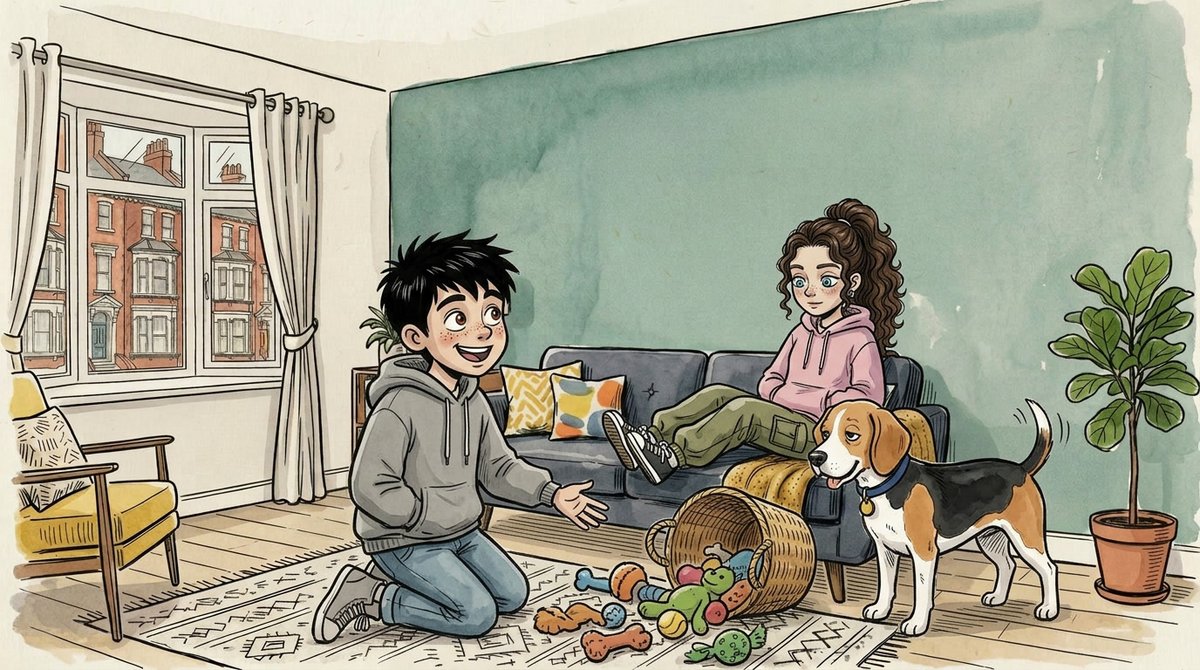
Counting Buster's toy basket. George tips out Buster's toy basket and counts ten toys with Rosie, then the two of them group them by kind — until they spot his favourite blue ball right there next to the teddy.
Episode worksheets (2)
- Student sheet In your teacher account
- Teacher sheet In your teacher account
Teaching guide
Objective & content
George tips out Buster's toy basket and counts the pile with his sister Rosie: ten toys, and then the groups inside it (four balls, three bones, two ropes and a teddy). The episode revises counting from one to ten in one unbroken sequence and contrasts two present tenses: the present simple for a fact (He has four balls and three bones.) and the present continuous for an action now (I'm counting Buster's toys.). The vocabulary is toys (toy, ball, bone, rope, teddy). Learners listen, then check their understanding with the in-app quiz.
Pedagogical guide
A short pile of ten keeps the count easy to follow, so attention goes to the grammar: I'm counting describes what is happening now, he has states a fact. Learners often want one tense for both, so ask them to sort each sentence into "now" or "fact".
Suggested procedure
- (5 min) Warm-up: hold up a few classroom objects, ask How many? and count together from one to ten.
- (3 min) Preview the five toy words with pictures or mime.
- (4 min) First listen: what is George doing, and how many toys are there?
- (8 min) Second listen: pause to write how many balls, bones and ropes, then find the blue ball.
- (7 min) Sort three sentences from the script into "now" and "fact".
- (6 min) Pairs count their own things and say one sentence each with has or have.
Materials & prerequisites
The episode in the PLAY app (audio, slideshow, text and quiz), a student sheet and a teacher sheet with the answer key. Learners need the numbers one to ten and the verb be.
Curriculum alignment
Cycle 3 (6e), axis "The child and their close environment": toys and pets.
Possible adaptations
- Lower levels: Offer segmented listening and additional visual aids.
- Advanced levels: Encourage an oral summary and a debate in English on the theme.
- Large groups: Organise group work with differentiated roles.
🔒 Restricted content
This resource requires a subscription to be viewed.
Unlock the resourceIncluded in the subscriptionTags
- Journey (dialogue)
- Present simple
- Present continuous
- Present simple vs continuous
- Numbers 1-100
- Games
- Pets
- Child and close environment
- Listening comprehension
- Vocabulary building
- Grammar practice
- Singular and plural
- Free time & hobbies
- Animals & nature
- Everyday Life
- Our World