S2 Bonfire Night - Sparklers and Toffee Apples
Episode of the series Meet My Family
- Illustrated slideshow (32 images)
- Glossary (14 words)
- Comprehension quiz (16 questions)
 Extract · 30 s
The episode
Bonfire Night; can / can't (ability and permission) + couldn't (past ability)
Episode worksheets (2)
- Student sheet In your teacher account
- Teacher sheet In your teacher account
Teaching guide
Objective & content
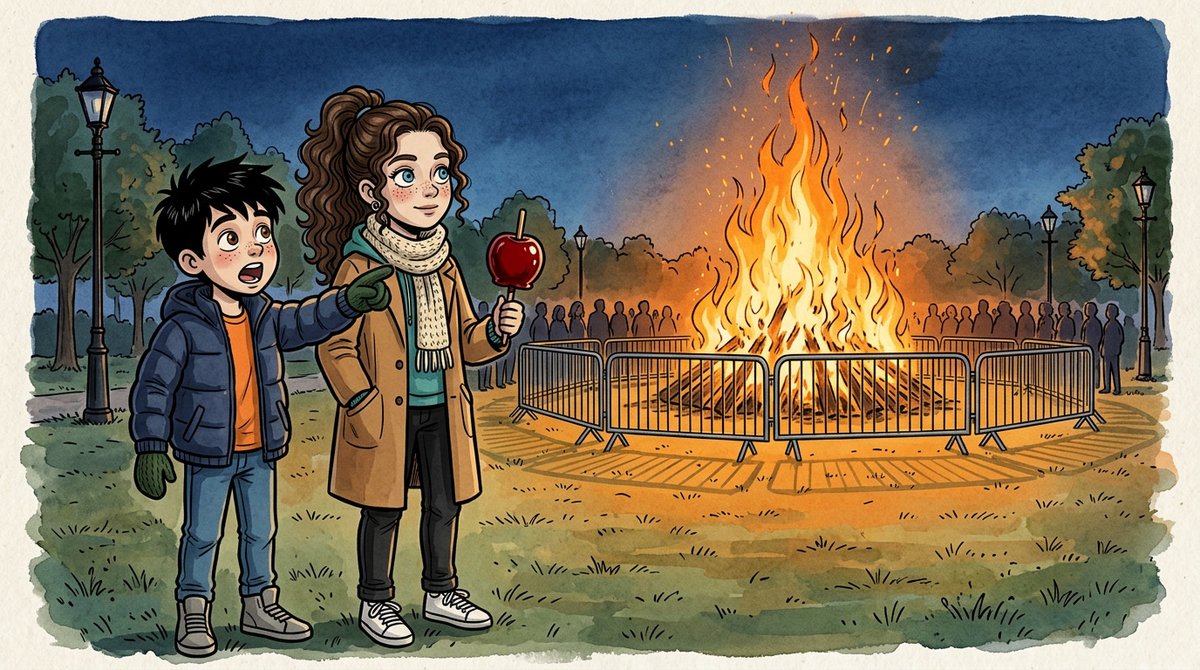
George and Rosie are in the park with Dad on Bonfire Night, the fifth of November: Rosie explains the custom (Guy Fawkes and Parliament in 1605) while a huge bonfire burns and the crowd waits for the fireworks. George's sparkler goes out before he can finish his name, then a bite of toffee apple sticks Rosie's teeth together, and for a whole minute she cannot answer back. The grammar is can and can't for asking, giving and refusing permission and for ability now (I can't open my mouth.), with couldn't for ability in the past. The vocabulary covers Bonfire Night (bonfire, fireworks, sparkler, toffee apple, bucket of water) and words such as sticky, stuck and fair. Learners listen, then check their understanding with the in-app quiz.
Pedagogical guide
The evening produces the grammar: George asks if he can write his name with a sparkler, Dad answers with a rule, and a sister who cannot talk makes can't for ability concrete. One verb carries two meanings, so ask pupils whether each line is about permission or about being able. Can, can't and couldn't take the bare verb, with no to and no -s: German pupils often say I can't to..., and some pupils use can't for the past where George says couldn't. Italian often renders couldn't as non sono riuscito or non potevo, so present it as one fixed past form. The history stays at two lines (Guy Fawkes and Parliament in 1605); safety is in the pictures (gloves, Dad lighting every sparkler, the bucket of water), for pupils to spot rather than for a safety talk.
Suggested procedure
- (3 min) Write 5 November on the board and ask what people do in Britain on that day; give the name, Bonfire Night.
- (5 min) Preview the evening's words with pictures: bonfire, fireworks, sparkler, toffee apple, gloves, sticky, stuck.
- (4 min) First listen: where are the family, and what goes wrong for George and for Rosie?
- (8 min) Second listen with three pauses: what Guy Fawkes wanted to do, why George couldn't finish his name, why Rosie can't talk.
- (10 min) Comprehension and vocabulary: parts 1 and 2 of the student sheet.
- (8 min) Sort the dialogue's can, can't and couldn't lines into permission, ability now and ability in the past, then part 3 of the student sheet.
- (7 min) Role-play in pairs: one pupil asks Dad for a sparkler, the other answers with a rule, then swap.
Materials & prerequisites
The episode in the PLAY app (audio, slideshow, text and quiz), a student sheet and a teacher sheet with the answer key. Learners need the present simple and a few past simple forms (wanted, caught, went out, bought). A picture of a sparkler and of a toffee apple helps the vocabulary preview.
Curriculum alignment
Cycle 4 (5e), axis "Encountering others": a British festival, its history and its customs, shared by a family in the park.
Possible adaptations
- Lower levels: Offer segmented listening and additional visual aids.
- Advanced levels: Encourage an oral summary and a debate in English on the theme.
- Large groups: Organise group work with differentiated roles.
🔒 Restricted content
This resource requires a subscription to be viewed.
Unlock the resourceIncluded in the subscriptionTags
- Journey (dialogue)
- Can: ability
- Can: permission
- Modals in the past
- Birthdays & parties
- Food & drinks
- Guy Fawkes Night
- Encountering others
- Listening comprehension
- Vocabulary building
- Grammar practice