S2E08 - Stage Fright
Episode of the series Meet My Family
- Illustrated slideshow (30 images)
- Glossary (11 words)
- Comprehension quiz (15 questions)

 Extract · 30 s
The episode
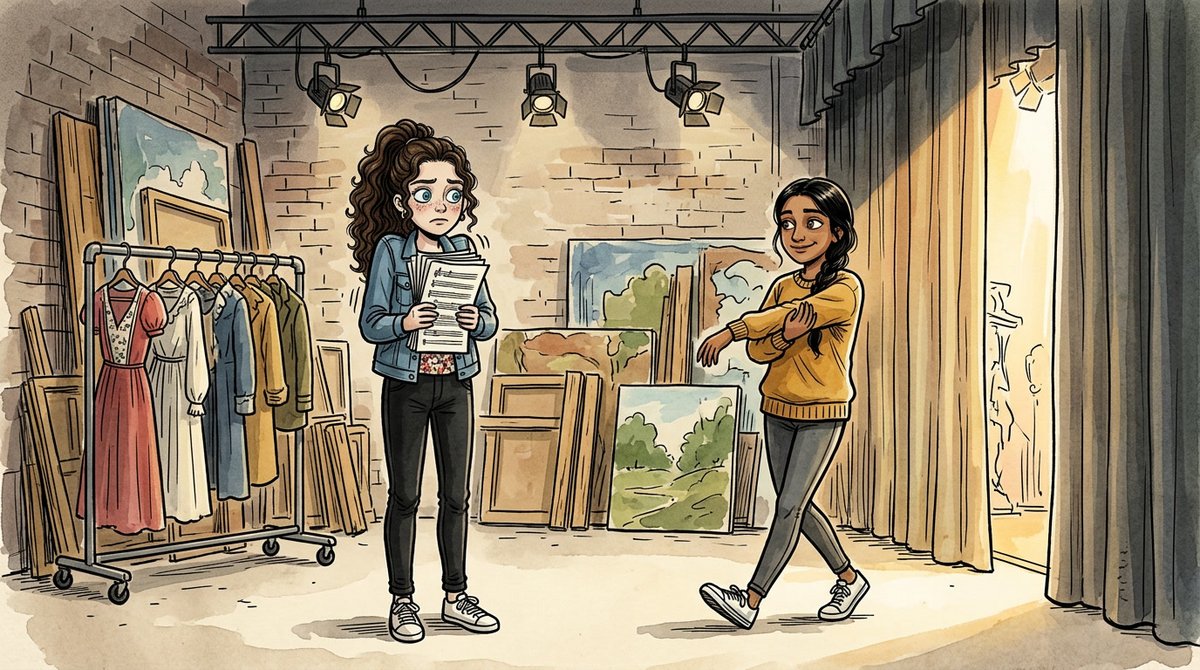
Just Before the Curtain. Rosie's hands won't stop shaking — but Priya's exactly the friend she needs backstage.
Episode worksheets (2)
- Student sheet In your teacher account
- Teacher sheet In your teacher account
Teaching guide
Objective & content
Moments before the curtain rises, Rosie is gripping her sheet music and shaking, while Priya loosens up with a goofy pre-show ritual. The episode teaches be + a feeling adjective in positive, negative and question forms (I'm so nervous, Priya; Aren't you nervous at all?). The vocabulary field is feelings (nervous, calm, excited, ridiculous, ritual). Learners follow how Rosie's mood changes, listening first, then checking understanding with the in-app quiz.
Pedagogical guide
French and German learners often say I have nervous, calquing j'ai peur, instead of I am nervous. The script also contains a trap worth writing on the board: Priya says Even famous musicians get nervous, and Rosie answers Do they?, not Are they?.
Suggested procedure
- (3 min) Ask whether they have been nervous before a test or a match, and collect the feeling words they know.
- (5 min) Introduce Rosie and Priya, then preview nervous, calm, ridiculous and ritual with faces and mimes.
- (4 min) First listen: how does Rosie feel at the start, and at the end?
- (8 min) Second listen with pauses after You look completely ridiculous, the dropped sheet music and I do feel calmer now.
- (7 min) Build the positive, negative and question forms on the board, and write be nervous beside get nervous.
- (6 min) Pairs say how they feel before something stressful: I'm ... before ... I'm not ... Are you ...?
Materials & prerequisites
The episode in the PLAY app (audio, slideshow, text and quiz), a student sheet and a teacher sheet with the answer key. Learners need the verb be and a few basic adjectives.
Curriculum alignment
Cycle 4 (5e), axis "School and society": school life and how pupils feel about performing in public.
Possible adaptations
- Lower levels: Offer segmented listening and additional visual aids.
- Advanced levels: Encourage an oral summary and a debate in English on the theme.
- Large groups: Organise group work with differentiated roles.
🔒 Restricted content
This resource requires a subscription to be viewed.
Unlock the resourceIncluded in the subscriptionTags
- Journey (dialogue)
- Be (affirmative)
- Adjectives: basics
- Question forms
- Feelings & emotions
- School and society
- Listening comprehension
- Vocabulary building
- Grammar practice
- Friendship
- Arts & media
- Being Yourself
- Belonging & Home
- Everyday Life