S2E03 - Whose Phone Is This?
Episode of the series Meet My Family
- Illustrated slideshow (16 images)
- Glossary (11 words)
- Comprehension quiz (18 questions)
 Extract · 30 s
The episode
Mystery Solved!. Two identical phone cases, one missing phone — whose is whose?
Episode worksheets (2)
- Student sheet In your teacher account
- Teacher sheet In your teacher account
Teaching guide
Objective & content
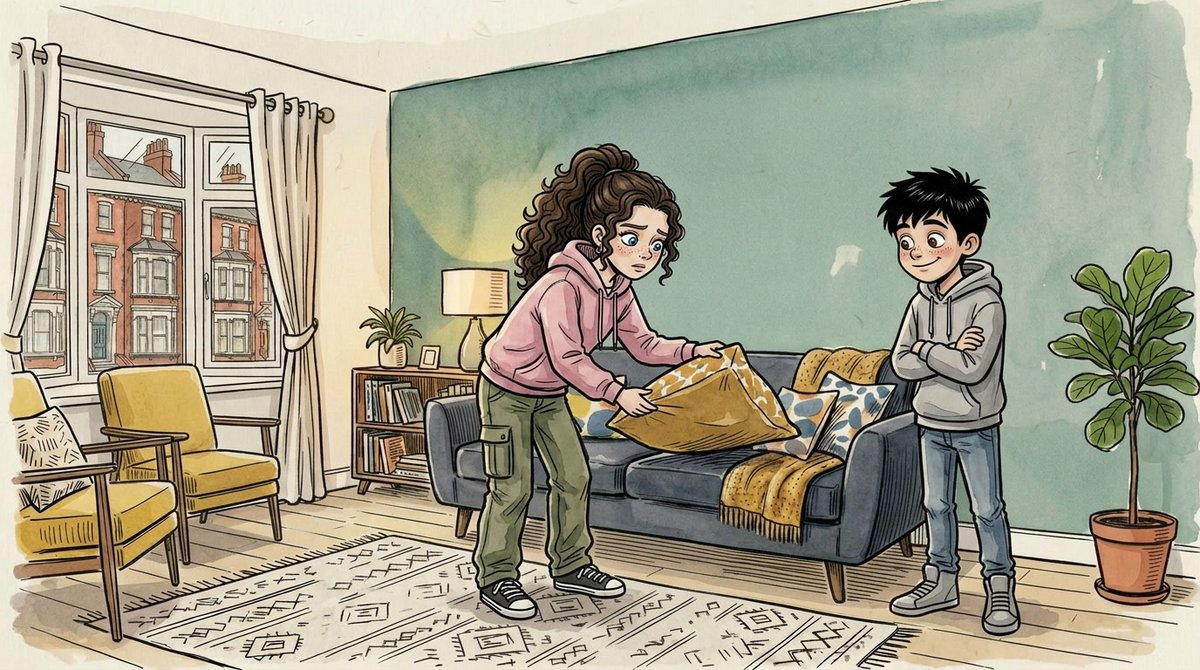
Rosie searches the living room for her phone and finds two identical cases on the charger, so she and George use a scratch, a lock screen and a charger colour to sort out whose is whose. The episode teaches possessives: the question whose, possessive adjectives before a noun (my phone), possessive pronouns that stand alone (that one's mine) and the genitive 's (That's Dad's charger). The vocabulary field is the digital world and everyday objects. Learners listen for the clues, then check understanding with the in-app quiz.
Pedagogical guide
The trap is my versus mine, and both appear in the script, so pupils can hear the contrast. Someone else's looks odd because the 's attaches to two words; point out that it behaves like a name. Scratch, identical and mystery are supported by the pictures, so treat them as recognition words.
Suggested procedure
- (5 min) Hold up a classroom pen: Whose pen is this? Pupils claim the objects.
- (7 min) First listen, books closed: what is the problem, and how do they solve it?
- (10 min) Second listen with the comprehension worksheet; pause after George spots the scratch and ask how they will identify the second phone.
- (10 min) Build a table from the script: whose, mine / yours / his, my / your / his + noun, Dad's.
- (8 min) Object game: pupils put one possession in a pile and claim items by asking Whose ... is this?
- (5 min) Wrap-up: one sentence about labelling something so nobody takes it.
Materials & prerequisites
The episode in the PLAY app (audio, slideshow, text and quiz), a student sheet and a teacher sheet with the answer key. Learners need the present simple and basic possessives (my, your).
Curriculum alignment
Cycle 4 (5e), axis "School and society": everyday objects and the digital world of school-age learners.
Possible adaptations
- Lower levels: Offer segmented listening and additional visual aids.
- Advanced levels: Encourage an oral summary and a debate in English on the theme.
- Large groups: Organise group work with differentiated roles.
🔒 Restricted content
This resource requires a subscription to be viewed.
Unlock the resourceIncluded in the subscriptionTags
- Journey (dialogue)
- Possessive adjectives
- Possessive pronouns
- Genitive 's
- Digital world
- School and society
- Listening comprehension
- Vocabulary building
- Grammar practice
- Technology & media
- Family
- Everyday Life
- Belonging & Home